



Quick Answer
To monitor a construction site after hours, combine strategically placed surveillance cameras, AI-powered video analytics, live remote monitoring, and a defined response plan. Mobile surveillance units can provide flexible coverage during early or changing project phases, while fixed cameras can support longer-term monitoring as the site develops. When suspicious activity is detected, trained monitoring professionals can verify the threat, issue live audio warnings, and escalate verified incidents when necessary.
The goal is not simply to record what happens overnight. Effective after-hours construction security should help detect and deter threats before they become theft, vandalism, damage, or a larger project loss.
Key Takeaways
- Construction sites are particularly vulnerable after crews leave because valuable equipment and materials remain while natural surveillance decreases.
- Cameras should cover high-risk areas such as entrances, equipment, material storage, trailers, and the site perimeter.
- AI video analytics can identify suspicious activity and alert trained monitoring professionals.
- Live audio warnings allow operators to intervene before an intrusion becomes a loss.
- Mobile surveillance units are particularly useful during early construction phases or when site layouts and security needs change.
- Effective after-hours monitoring requires a response plan, not just cameras.
- Security should evolve throughout the project as buildings, materials, access points, and risks change.
Why Do Construction Sites Need After-Hours Monitoring?
Construction sites can become significantly more vulnerable after working hours because crews leave while valuable equipment, materials, tools, and partially completed structures remain exposed.
Unlike a completed commercial property, a construction site is constantly changing.
One week, the primary risk may be equipment stored around an open perimeter. Later, expensive materials may arrive. Eventually, finished interiors, installed systems, and other high-value assets create new security concerns.
After-hours threats can include:
- Equipment theft
- Tool theft
- Material theft
- Copper and other metal theft
- Vandalism
- Trespassing
- Unauthorized vehicle access
- Damage to completed work
- Fire or other catastrophic events
The consequences can also extend beyond the value of whatever is stolen.
A security incident can contribute to project delays, replacement costs, insurance claims, schedule disruption, and additional labor.
That’s why construction security should focus on preventing losses, not simply documenting them.
How Do You Monitor a Construction Site After Hours?
Effective after-hours remote video monitoring uses layers of technology and human response to maintain visibility after crews leave and intervene when suspicious activity occurs.
A practical process looks like this:
Step 1: Identify the Site’s Highest-Risk Areas
Start by identifying what needs protection and where unauthorized people are most likely to enter.
Priorities may include:
- Vehicle entrances
- Pedestrian access points
- Perimeter fencing
- Equipment storage
- Material laydown areas
- Trailers
- Fuel storage
- Newly installed systems
- Completed portions of the building
The objective is to prioritize areas where an intrusion could create the greatest loss or disruption.
Step 2: Establish Camera Coverage
Place cameras so they provide useful visibility across those high-risk areas.
Depending on the project’s stage, this may involve:
- Mobile surveillance units
- Fixed cameras
- Existing site cameras
- A combination of mobile and permanent surveillance
Camera placement should be intentional. More cameras do not automatically mean better security if they leave critical assets or access points outside the usable field of view.
Step 3: Use Video Analytics to Detect Activity
Modern construction surveillance systems can use AI-powered analytics to identify activity that may require attention.
Examples include:
- A person entering after hours
- A vehicle crossing a defined perimeter
- Loitering near equipment
- Movement in a restricted area
- Unauthorized access to material storage
Instead of relying on someone to continuously watch every camera, analytics help surface events that require human review.
Step 4: Have Trained Professionals Verify Alerts
An alert alone does not confirm that a crime is occurring.
A monitoring professional can review the event and determine whether the activity involves:
- An authorized worker
- A contractor
- Normal site activity
- Environmental movement
- A potential intruder
Human verification adds context before the response begins.
Step 5: Intervene While the Event Is Happening
If the activity is unauthorized, operators can follow the site’s predetermined response plan.
Depending on the circumstances, that may include:
- Issuing a live audio warning
- Contacting the superintendent or another site contact
- Continuing to track the individual
- Escalating a verified threat to law enforcement
This is where monitored surveillance differs fundamentally from passive cameras.
The objective is to address the intrusion before equipment disappears, materials are stolen, or property is damaged.
After-Hours Construction Monitoring Process
| Step | What Happens | Objective |
| Assess | Identify assets and high-risk areas | Understand exposure |
| Cover | Position cameras strategically | Maintain visibility |
| Detect | AI identifies relevant activity | Find threats early |
| Verify | Monitoring professionals assess the event | Confirm what’s happening |
| Intervene | Audio or other response procedures begin | Deter escalation |
| Escalate | Verified threats receive additional response | Protect the site |
| Document | Video and incident details are retained | Support follow-up |
Where Should Cameras Be Placed on a Construction Site?
Security cameras should prioritize entrances, perimeters, high-value assets, and areas where unauthorized activity is most likely to occur.
Common locations include:
Entrances and Exits
Vehicle gates and pedestrian access points provide visibility into who enters and leaves the site.
Equipment Areas
Heavy machinery, generators, tools, and other valuable equipment can be attractive theft targets.
Material Storage
Monitor locations containing high-value or easily resold materials, particularly as deliveries arrive throughout the project.
Perimeter Areas
Cameras positioned around fencing and other boundaries can help identify unauthorized entry before someone reaches valuable assets.
Trailers and Temporary Buildings
Jobsite offices and storage trailers may contain equipment, records, electronics, and tools.
Completed Work
As construction progresses, surveillance priorities should expand to protect newly installed equipment and finished areas.
Key Insight
Construction camera placement should change with the project. The areas requiring the most protection during site preparation may not be the same areas that present the greatest risk during finishing and closeout.
How Does Live Video Monitoring Protect a Jobsite Overnight?
Live video monitoring turns construction cameras from passive recording devices into a proactive security system capable of supporting real-time intervention.
With traditional surveillance, a contractor may arrive in the morning and discover that equipment or materials are missing.
The cameras may show what happened, but the loss has already occurred.
With live monitoring, the sequence changes.
Detection → Verification → Intervention → Escalation
AI-powered analytics identify suspicious activity. A trained monitoring professional verifies what’s happening. If necessary, an operator can issue a live audio warning or initiate the site’s established escalation procedure.
Recorded video remains valuable, but it becomes one component of a larger loss-prevention strategy.
When Should You Use Mobile Surveillance Units?
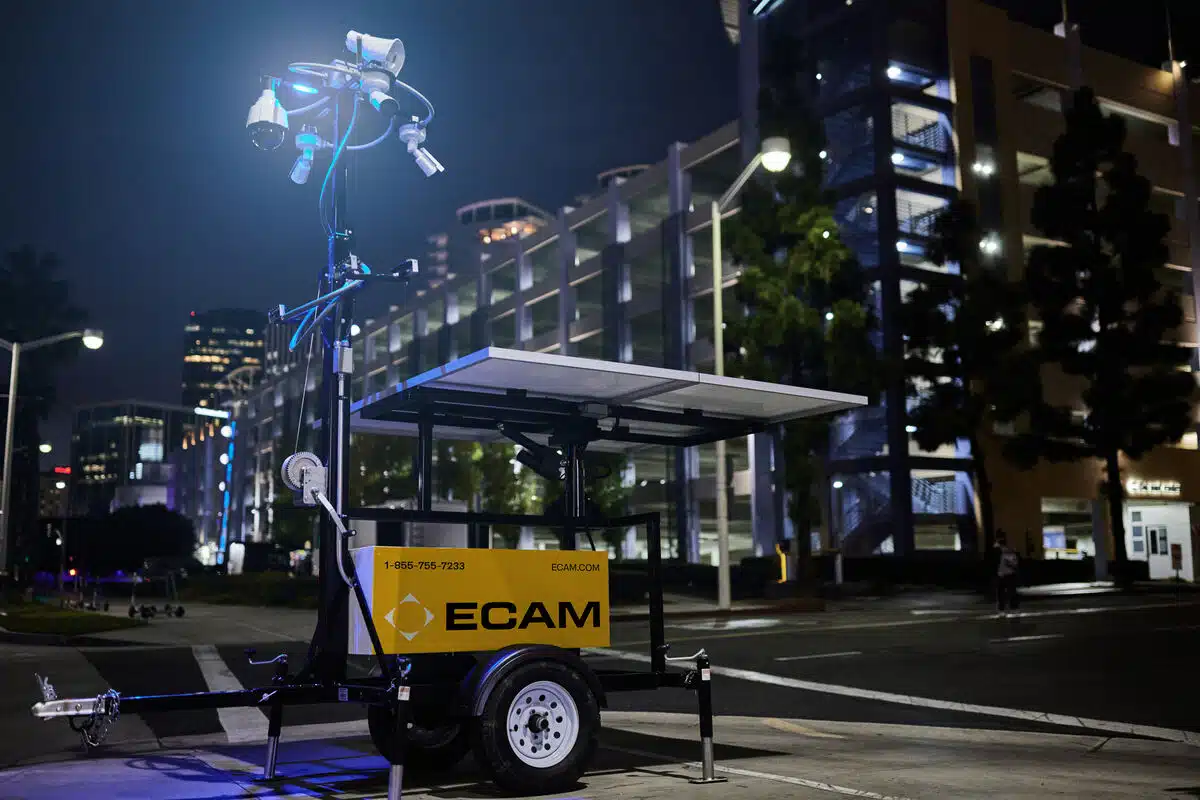
Mobile surveillance units are particularly useful when a construction site lacks permanent infrastructure or when security needs change as the project progresses.
Early in construction, sites may not have:
- Permanent electricity
- Internet connectivity
- Buildings suitable for fixed cameras
- Finalized entrances
- Stable perimeter layouts
A mobile surveillance unit packages cameras, connectivity, power options, analytics, and monitoring capabilities into a rapidly deployable platform.
Depending on the configuration, units can use solar power, battery storage, cellular connectivity, and backup power options.
They can also be repositioned.
If equipment moves from one side of the property to another or a new material storage area becomes the primary risk, surveillance coverage can move with it.
As the project matures, mobile units can work alongside fixed camera systems or be redeployed where temporary coverage is still needed.
How Should Construction Security Change Throughout the Project?
Construction security should evolve alongside the project because risks, assets, access points, and site conditions continually change from groundbreaking through completion.
A one-time security plan created at the beginning of construction may become outdated quickly.
| Project Phase | Potential Security Priority | Monitoring Approach |
| Site preparation | Perimeter intrusion, equipment | Mobile surveillance and perimeter coverage |
| Structural work | Equipment, materials, access points | Repositioned cameras and live monitoring |
| Building enclosure | Interior access, new entry points | Expanded interior and exterior coverage |
| Systems installation | Copper, electrical, HVAC, high-value components | Targeted monitoring of valuable assets |
| Finishing | Fixtures, appliances, completed work | Broader asset and interior protection |
| Closeout | Completed property, reduced site staffing | Transition toward permanent security |
This is especially important because the financial consequences of an incident can grow as the project advances.
The later the project, the more completed work may be exposed to damage, and a significant incident can affect schedules, budgets, insurance claims, and ultimately project delivery.
What Happens When Someone Enters a Construction Site After Hours?
Consider an individual approaching a material storage area late at night.
With proactive monitoring, the response could work like this:
- A camera captures the person entering the monitored area.
- Video analytics identify unauthorized after-hours activity.
- An alert is sent to the monitoring center.
- A trained operator reviews the live video.
- The activity is verified as suspicious.
- A live audio warning is issued.
- The operator continues observing the situation.
- If the person leaves, the event is documented.
- If the threat continues, law enforcement or site contacts can be notified according to the response plan.
The ideal outcome isn’t an arrest or even an investigation.
It’s preventing the incident from becoming a loss in the first place.
What Should You Look for in an After-Hours Construction Monitoring Solution?
When evaluating construction security providers, look beyond the cameras themselves.
Ask whether the solution provides:
Proactive Detection
Does the system identify suspicious activity while it is occurring?
Professional Monitoring
Are trained professionals available to verify alerts and determine what happens next?
Live Audio
Can operators warn unauthorized individuals before an incident escalates?
Flexible Deployment
Can cameras or mobile surveillance units be repositioned as construction progresses?
Reliable Power and Connectivity
Can the solution operate before permanent utilities are available?
Defined Response Procedures
What happens when an actual threat is identified?
Incident Documentation
Will you receive useful video and reporting following security events?
Scalability
Can the security program change as the site moves from groundbreaking to completion?
A construction monitoring strategy should ultimately be designed around the project’s risks rather than forcing every phase into the same security configuration.
Frequently Asked Questions
Can you monitor a construction site without power?
Yes. Mobile surveillance units can provide security at sites without permanent power by using configurations that may include solar panels, batteries, cellular connectivity, and backup power.
Does someone need to watch construction cameras all night?
Not necessarily. AI-powered video analytics can identify activity that requires attention, allowing trained monitoring professionals to focus on relevant alerts instead of continuously watching every camera feed.
Can construction cameras stop theft?
No security system can guarantee that theft will never occur. However, proactive monitoring can detect suspicious activity and enable intervention before an intrusion develops into a completed theft.
Are mobile surveillance units better than fixed cameras for construction?
It depends on the project phase. Mobile units are especially valuable when infrastructure and site layouts are changing, while fixed cameras can become increasingly useful as buildings and permanent infrastructure are established.
Should construction sites use security guards after hours?
Some sites benefit from on-site guards, particularly when physical access control or an immediate physical presence is required. Others may use remote video monitoring for broader surveillance coverage, while higher-risk projects can combine both approaches.
How often should a construction site’s security plan be reviewed?
Security should be reassessed as the project changes, particularly when new materials arrive, high-value systems are installed, access points change, or construction moves into a new phase.
Bottom Line
The most effective way to monitor a construction site after hours is to combine strategic camera coverage, AI-powered detection, trained live monitoring professionals, and a response plan designed to intervene before an incident becomes a loss.
Mobile surveillance units can establish coverage early, even before permanent infrastructure is available. As construction advances, surveillance can move and expand alongside changing risks, protecting everything from heavy equipment and materials to installed systems and completed work.
That flexibility matters because construction security isn’t a one-time decision. A jobsite changes every day, and the consequences of theft, vandalism, or a catastrophic loss can extend far beyond the value of the stolen property.
Effective after-hours monitoring gives contractors a way to protect the project throughout its lifecycle, with the ultimate goal of keeping work moving, reducing preventable losses, and getting the project to completion.
Build a Stronger Security Strategy

Download Security Guides
Practical ebooks to help you strengthen your security and solve your challenges.

Discover Industry Security Solutions
See how ECAM protects your industry with solutions designed to deter crime, reduce losses, and keep operations moving.