



Quick Answer
A mobile surveillance unit (MSU) typically costs about $1,200 to $4,000+ per month to rent, while purchasing a unit can cost approximately $18,000 to $50,000 or more. Actual pricing depends on the cameras, power system, AI analytics, connectivity, live monitoring, deployment requirements, and length of service.
But price alone can be misleading because not all mobile surveillance units provide the same level of protection. Two MSUs at very different price points may differ substantially in camera coverage, detection capabilities, uptime, monitoring, deterrence, and response. A lower monthly price can quickly lose its advantage if the system misses an intrusion, goes offline, generates excessive false alarms, or only records an incident instead of helping prevent it.
For businesses comparing options, the more important question is therefore not simply, “How much does an MSU cost?” It is “What security capabilities am I getting for that cost?”
Key Takeaways
- Pricing generally falls around $1,200 to $4,000+ per unit per month, depending on configuration and service level.
- Purchasing an MSU can require an upfront investment of approximately $18,000 to $50,000+, with higher-end configurations costing more.
- Camera configuration, AI analytics, solar and battery capacity, connectivity, monitoring, and deployment requirements can all affect price.
- Not all MSUs are created equal. Similar-looking units can provide very different levels of coverage, reliability, detection, monitoring, and response.
- Choosing an MSU based solely on the lowest monthly price can create security gaps that ultimately cost more than the initial savings.
- A low advertised rate may not include professional monitoring, delivery, installation, connectivity, maintenance, or other services.
- Businesses should compare total security value and included capabilities rather than equipment price alone.
Why Isn’t the Cheapest MSU Always the Best Value?
The cheapest mobile surveillance unit is not necessarily the least expensive security solution because MSUs can differ substantially in what they detect, how reliably they operate, and what happens when a threat is identified.
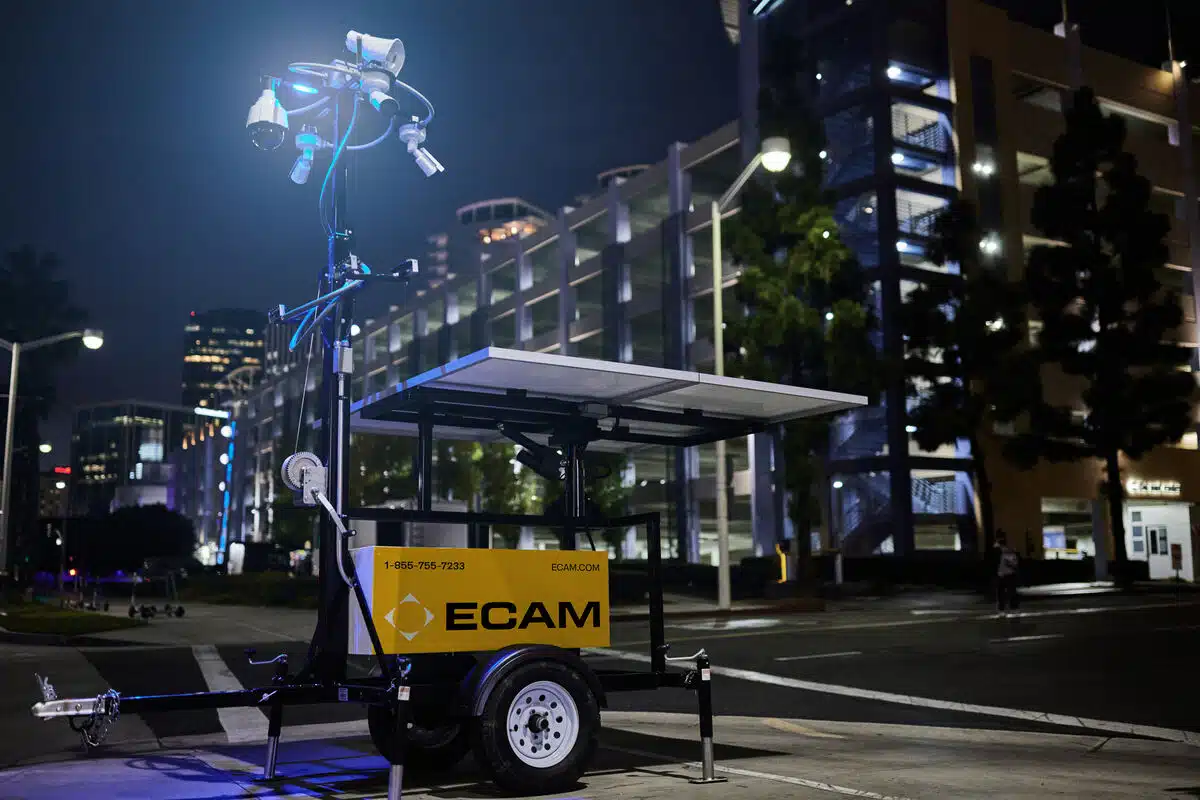
From a distance, two units may look nearly identical.
Both may have a trailer, mast, solar panels, and cameras.
But what’s inside the system and behind those cameras can be very different.
Differences may include:
| Capability | Questions to Consider |
| Camera coverage | How much of the property can the unit actually see? |
| Camera quality | Can operators clearly identify relevant activity? |
| AI analytics | What events can the system accurately detect? |
| Monitoring | Who reviews alerts, and when? |
| Response | Can operators actively intervene? |
| Audio deterrence | Can someone warn an intruder in real time? |
| Power | How reliably can the system operate off-grid? |
| Connectivity | What happens if the primary connection fails? |
| Uptime | How consistently is the unit operational? |
| Maintenance | Who identifies and fixes equipment problems? |
| Support | Who is responsible when something goes wrong? |
This is where shopping on price alone can become expensive.
Imagine one MSU costs several hundred dollars less per month but provides limited analytics and no professional live monitoring.
Someone enters the property overnight and steals $20,000 worth of equipment.
The cameras capture excellent footage.
But nobody responds until the next morning.
The business technically saved money on surveillance, but it did not necessarily save money on security.
Key Insight
The purpose of an MSU isn’t to be the cheapest camera trailer on the property. It’s to help prevent losses.
The real cost of a security solution should therefore include what happens when that solution fails to detect, deter, or respond to the event it was deployed to prevent.
What Are You Actually Paying for With an MSU?
When businesses compare MSU quotes, it can be tempting to treat the physical unit as the product.
But the trailer itself is only one component.
A professionally monitored MSU can represent an entire security system:
Cameras → AI Detection → Human Verification → Live Intervention → Escalation → Documentation
Each layer matters.
If a solution has cameras but weak detection, an event may be missed.
If it detects an event but nobody verifies it, response can suffer.
If someone verifies the event but cannot intervene, the system may still function primarily as a recording tool.
If the unit regularly loses power or connectivity, none of those capabilities matter while it is offline.
That’s why two MSUs with dramatically different prices may not actually represent equivalent security services.
How Should Businesses Compare MSU Quotes?
Don’t simply ask:
“How much is the unit per month?”
Ask:
“What happens at 2:00 a.m. when someone enters my property?”
Then work backward.
A meaningful MSU comparison should answer:
- Will the system detect them?
What analytics are being used, and what activity can they identify? - Will someone know they’re there?
Is professional monitoring included, or does the system simply send an alert? - Will someone verify what’s happening?
Are trained monitoring professionals reviewing the event? - Can someone intervene?
Does the unit support live audio deterrence or another real-time response? - What happens if the individual doesn’t leave?
What escalation procedures are in place? - Will the system actually be operational when the incident occurs?
What power, connectivity, system-health monitoring, maintenance, and support are included?
Only after answering those questions should businesses compare the monthly price.
Price vs. Security Value
| Lower Price May Mean | Higher-Value Managed Solution May Include |
| Camera hardware | Commercial-grade camera coverage |
| Basic recording | AI-powered threat detection |
| Automated notifications | Human alert verification |
| Customer-managed response | Professional live monitoring |
| Limited deterrence | Live audio intervention |
| Basic connectivity | Managed connectivity |
| Equipment rental | Ongoing maintenance and support |
| Footage after an incident | Response while an incident is happening |
Not every lower-priced MSU lacks these capabilities, and not every higher-priced unit automatically provides them.
The point is that price alone doesn’t tell you.
You have to compare what the provider is actually delivering.
Bottom Line
A mobile surveillance unit typically costs approximately $1,200 to $4,000+ per month to rent, while purchasing one can require an investment of roughly $18,000 to $50,000 or more.
Those numbers provide a useful budgeting benchmark, but they shouldn’t determine the decision by themselves.
Not all MSUs are created equal.
Two units can look similar while providing substantially different camera coverage, AI detection, power reliability, connectivity, live monitoring, deterrence, maintenance, and response capabilities. Saving several hundred dollars per month has little value if the cheaper system fails during the incident it was installed to prevent.
Businesses should therefore compare MSUs based on total security value, not simply rental price.
Ask what the system can see. Ask what it can detect. Ask who is monitoring it. Ask what happens when an intruder appears. Ask how the provider keeps the system operational.
Then compare the price.
Because the real measure of an MSU isn’t how little it costs to put one on your property.
It’s how effectively it protects what you put it there to secure.
Build a Stronger Security Strategy

Download Security Guides
Practical ebooks to help you strengthen your security and solve your challenges.

Discover Industry Security Solutions
See how ECAM protects your industry with solutions designed to deter crime, reduce losses, and keep operations moving.