



Security decisions are often framed around cost.
How many guards are needed. How many cameras should be installed. What the upfront investment will look like. These are important considerations, but they rarely tell the full story.
What matters more over time is return.
How effectively a system prevents incidents, how consistently it operates, and how efficiently it scales across locations all contribute to the real cost of security. When evaluated through that lens, remote video monitoring services introduce a different way to think about both cost and performance.
The Cost Structure of Traditional Security
Most security strategies are built on two primary components: on-site personnel and camera systems.
Security guards provide presence and deterrence, but their cost is directly tied to time and coverage. Expanding protection typically requires adding more personnel, which increases cost in a linear way. Even then, coverage is limited by where those individuals are at any given moment.
CCTV systems, on the other hand, provide coverage without ongoing labor costs. However, they are often used passively. Footage is recorded and reviewed after an incident, which means their primary value is documentation rather than prevention.
Individually, each approach addresses part of the problem.
Together, they often create a gap between visibility and response.
Where ROI Breaks Down in Traditional Models
The limitations of guards and CCTV are not always apparent upfront. They tend to emerge over time.
With on-site personnel, gaps in coverage can occur between patrols, during shift changes, or across large areas that cannot be monitored simultaneously. Increasing coverage requires additional staffing, which raises costs without guaranteeing complete visibility.
With CCTV, the issue is not coverage, but utilization. Cameras capture activity continuously, but without active monitoring, incidents may go unnoticed until after they have occurred. This delays response and limits the system’s ability to prevent loss.
In both cases, the system is working as designed, but the outcome is constrained by how it operates.
ROI is impacted not just by what is spent, but by what is missed.
How Remote Video Monitoring Changes the Economics
Remote video monitoring services shift the cost model from physical presence to centralized visibility.
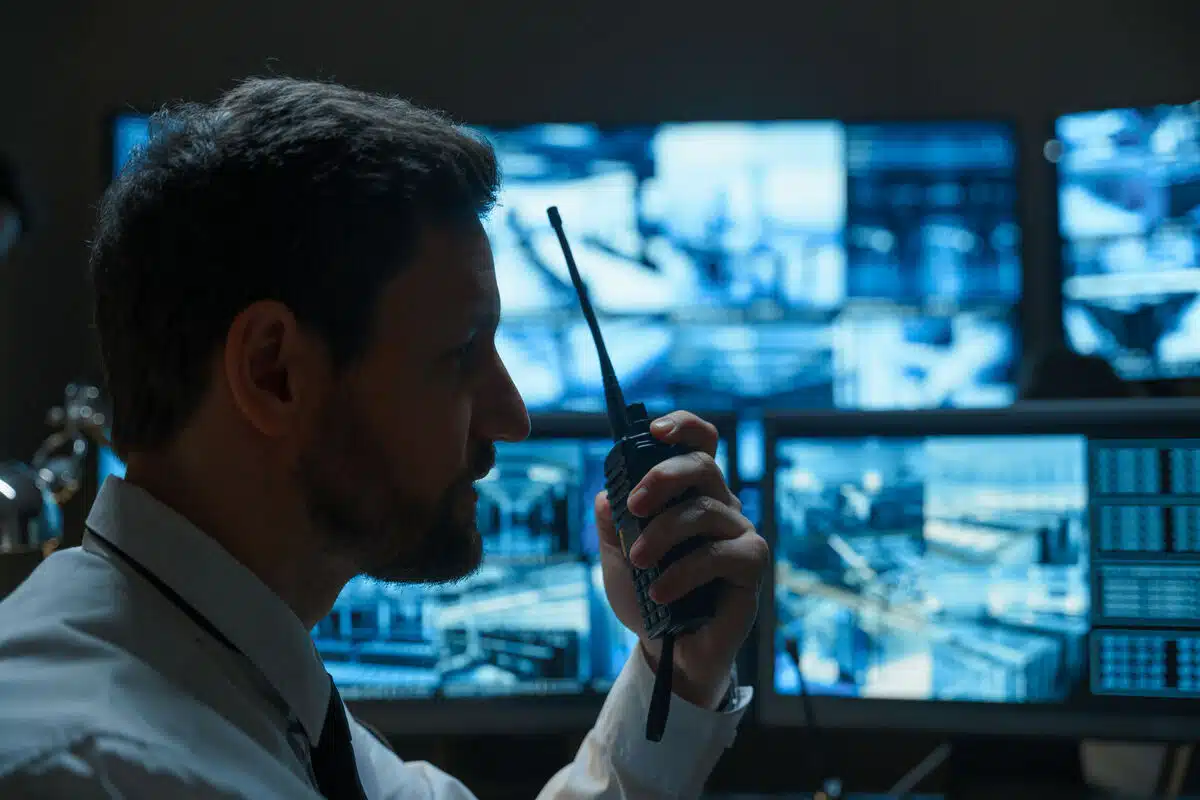
Instead of scaling security by adding personnel, organizations can extend coverage through monitored camera systems that are observed in real time. Monitoring teams can oversee multiple areas simultaneously, identifying and responding to activity as it occurs.
This creates a different economic structure.
Coverage is no longer tied directly to headcount. Multiple sites or large areas can be monitored without a proportional increase in cost, allowing organizations to scale more efficiently.
At the same time, active monitoring increases the effectiveness of existing camera infrastructure, turning passive systems into proactive ones.
Comparing Security Approaches Through an ROI Lens
When viewed through ROI, the differences between approaches become clearer.
On-Site Security Guards
Provide physical presence and immediate response, but are limited by location and time. Costs scale with staffing, and coverage gaps are difficult to eliminate entirely.
CCTV Systems
Offer broad visibility and documentation, but are typically reactive. Without monitoring, they do not influence events as they happen.
Remote Video Monitoring
Combines visibility with real-time observation and response. Monitoring teams can verify activity, intervene when necessary, and maintain consistent oversight across environments.
The distinction is not just in cost, but in capability.
The Role of AI and Verification in Improving Efficiency
One of the key factors influencing ROI in remote video monitoring is how events are identified and filtered.
Modern remote monitoring services often incorporate AI-driven analytics to detect relevant activity. These systems can differentiate between routine movement and behavior that warrants attention, reducing unnecessary alerts.
Monitoring teams then verify these events in real time, ensuring that responses are based on accurate information.
This combination of automated detection and human oversight improves efficiency by:
- Reducing false alarms
- Prioritizing meaningful events
- Allowing monitoring teams to focus on what matters
The result is a system that not only reduces noise, but also improves the quality of response.
Scaling Security Without Scaling Cost
One of the most significant ROI advantages of remote video monitoring is its scalability.
As organizations grow or expand across multiple locations, traditional security models require proportional increases in staffing or infrastructure. Remote monitoring, by contrast, allows for broader coverage without the same level of incremental cost.
This makes it particularly effective for:
- Multi-site operations
- Large or distributed environments
- Locations with variable activity levels
Security can expand alongside the business without becoming a limiting factor.
Beyond Cost: The Value of Consistency
ROI is not solely about reducing expenses.
It is also about improving consistency.
Remote video surveillance monitoring introduces standardized processes for detection, verification, and response. This reduces variability across sites and ensures that similar events are handled in similar ways.
Over time, this consistency contributes to better outcomes, fewer incidents, and more predictable performance.
Rethinking Security as an Investment
When security is evaluated only as a cost, decisions tend to focus on minimizing spend.
When it is evaluated as an investment, the focus shifts to performance.
Remote video monitoring services represent a shift in how that investment is structured. By combining real-time visibility, centralized oversight, and scalable coverage, they offer a way to improve both efficiency and effectiveness.
The result is not just lower cost, but better control over how security operates.
Security costs are easy to compare. Security outcomes are not. The difference between the two is where ROI is actually determined. Connect with ECAM to understand what remote video monitoring would look like and what it could return in your environment.
Build a Stronger Security Strategy

Download Security Guides
Practical ebooks to help you strengthen your security and solve your challenges.

Discover Industry Security Solutions
See how ECAM protects your industry with solutions designed to deter crime, reduce losses, and keep operations moving.