



When a Property Needs Protection, What Should You Actually Deploy?
A construction project begins before permanent cameras are installed. A vacant property starts experiencing trespassing. A logistics yard adds temporary trailer storage. A retailer needs additional parking lot protection during a high-risk period.
Each situation creates the same immediate question:
How do you put effective security where you need it?
For many businesses, the choice comes down to deploying security personnel or using a mobile surveillance unit (MSU).
Both can establish a visible security presence without waiting for permanent security infrastructure, but they protect properties in fundamentally different ways.
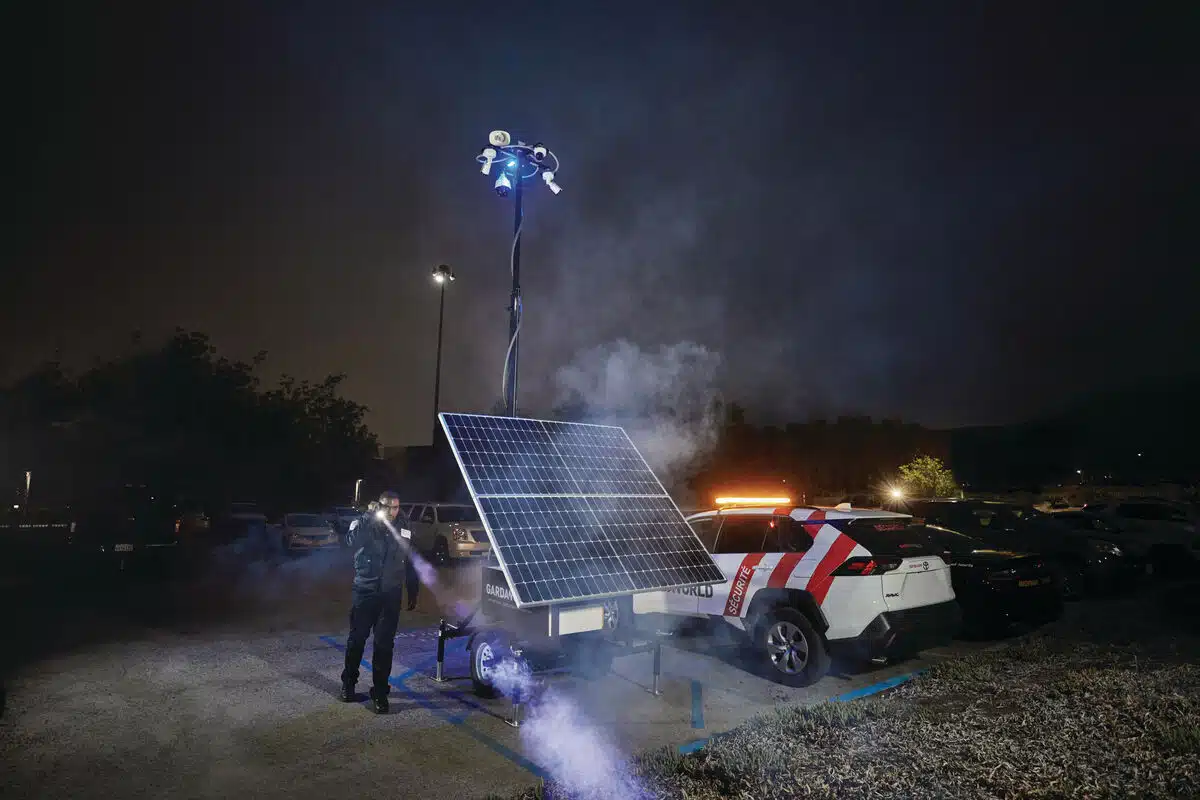
Security guards provide physical presence and direct human interaction. Mobile surveillance units combine elevated camera coverage, AI-powered detection, professional monitoring, and real-time deterrence in a rapidly deployable solution.
When comparing mobile surveillance units vs security guards, the right decision depends on what the location actually requires: physical personnel, continuous surveillance, or a combination of both.
Start With the Job Your Security Solution Needs to Do
It can be tempting to begin with cost.
How much does a guard cost per hour? How much does a mobile surveillance unit cost per month?
But that comparison only becomes meaningful once you understand what you’re asking each solution to accomplish.
If a location needs someone to check credentials, inspect vehicles, assist employees, or physically control access, a security guard may be the appropriate resource.
If the primary objective is to watch a perimeter, detect unauthorized activity, deter intruders, and escalate verified threats, assigning a person to continuously patrol the property may not be the most efficient approach.
That is where mobile surveillance units can provide a different model.
Rather than assigning security to a person at a post, an MSU establishes a monitored security presence around the areas where risk exists.
Mobile Surveillance Units vs Security Guards at a Glance
| Decision Factor | Mobile Surveillance Units | Security Guards |
| Primary Role | Provide monitored visibility, detection, and deterrence | Provide physical presence and on-site security support |
| Coverage Model | Elevated cameras monitor multiple designated areas | Coverage follows the guard’s post, position, or patrol route |
| Threat Detection | AI-powered detection with trained operator verification | Depends on direct observation by the guard |
| Response | Live audio intervention, stakeholder notification, and police dispatch when appropriate | On-site assessment and response within the guard’s responsibilities |
| Infrastructure Needs | Designed for rapid deployment, including locations with limited permanent infrastructure | Requires an appropriate guard post and supporting site conditions |
| Mobility | Can be relocated as security needs change | Personnel can be reassigned, but coverage depends on staffing |
| Scaling Coverage | Additional units or camera coverage can protect new risk areas | Additional posts or shifts generally require additional guard labor |
| Cost Model | Equipment and managed monitoring service | Recurring labor based on staffing and hours |
| Physical Interaction | No physical interaction with visitors or employees | Can perform access, inspection, escort, and other on-site duties |
| Best Fit | Perimeters, outdoor assets, temporary sites, evolving risks, and after-hours protection | Locations requiring direct human interaction or physical security duties |
The deciding factor is not simply technology versus people.
It is whether the security need is primarily observation and intervention or physical interaction and presence.
What a Mobile Surveillance Unit Actually Provides
A mobile surveillance unit is more than a camera mounted on a trailer or portable platform.
A professionally monitored MSU can bring several security capabilities together in one deployment:
- Elevated surveillance cameras
- AI-powered threat detection
- Live professional monitoring
- Audio deterrence
- Recorded video evidence
- Defined escalation procedures
- Flexible deployment
- Support for locations without permanent camera infrastructure
That combination makes MSUs particularly useful when a business needs to establish surveillance quickly or when security requirements are likely to change.
Consider a construction site.
Early in the project, there may be no permanent building, network, or camera infrastructure. Yet materials, tools, equipment, and temporary structures still need protection.
An MSU can establish coverage during those early phases and be repositioned as the project evolves.
The same flexibility can apply to overflow storage at a logistics facility, a vacant commercial property, an outdoor equipment yard, or a parking lot experiencing recurring after-hours activity.
What Security Guards Provide That an MSU Cannot
Mobile surveillance units are powerful security tools, but they do not replace every function of an on-site guard.
Security personnel can perform tasks that require a person to be physically present, including:
- Checking identification and credentials
- Managing entrances and gates
- Inspecting vehicles
- Escorting employees or visitors
- Conducting physical safety checks
- Assisting during emergencies
- Providing directions or customer support
- Responding to operational issues beyond surveillance
Those responsibilities matter.
If a guard post exists because people need to interact with a security professional, replacing that person with an MSU would leave an obvious operational gap.
The more useful question is whether the guard is performing those responsibilities or primarily being paid to watch property.
Coverage Changes the Economics
This is where the cost comparison becomes more interesting.
Security guard costs are tied closely to labor.
If a property requires overnight coverage seven days a week, enough guard hours must be purchased to cover those shifts. If a second location needs simultaneous coverage, additional staffing may be necessary.
An MSU scales differently.
A single unit may provide visibility across several strategically selected areas within its effective field of view. Monitoring operators can use AI-assisted detection to identify suspicious activity without requiring someone to physically patrol each area.
That means the relevant comparison is not:
What does one MSU cost compared with one hour of guard service?
It is:
What does it cost to provide the level of coverage the property actually requires?
For a site that needs physical personnel at a controlled entrance, guard labor may provide clear value.
For an outdoor property that primarily needs after-hours observation across equipment, materials, parking areas, or a perimeter, an MSU may provide broader coverage without the same staffing model.
Consider What Happens at 2:00 A.M.
Imagine an intruder enters an outdoor equipment yard after hours.
With a guard-based model, the outcome depends on where the guard is at that moment.
If the guard is positioned nearby or encounters the individual during a patrol, the activity may be identified quickly. If the guard is checking another portion of the property, the intrusion may go temporarily unnoticed.
A monitored MSU approaches the same event differently.
A strategically positioned camera can detect activity in the protected area. AI can identify the event, and a trained monitoring operator can verify what is happening.
Depending on the site’s established response plan, the operator may issue an audio warning, notify designated contacts, or contact law enforcement.
The MSU cannot physically approach the intruder.
But it does not have to be standing in the right place at the right moment to see the activity.
That difference is central to the MSU value proposition.
Where Mobile Surveillance Units Have the Advantage
MSUs are especially well suited to security challenges where visibility, flexibility, and speed of deployment matter.
Temporary or changing environments
Construction sites, temporary storage areas, and evolving facilities may not justify permanent security infrastructure.
An MSU can provide coverage while conditions change.
Large outdoor areas
Equipment yards, parking lots, logistics facilities, and material storage areas can be difficult to cover consistently through foot patrols alone.
Elevated camera positions can provide broader visibility across designated areas.
Remote or lightly staffed properties
Energy infrastructure, vacant properties, and remote facilities may require protection even when few or no employees are present.
A monitored unit can establish a security presence without requiring continuous on-site staffing.
Recurring after-hours problems
Properties experiencing repeated trespassing, vandalism, theft, or unauthorized access may benefit from a solution specifically designed to detect and address activity during vulnerable periods.
Rapidly emerging security needs
Sometimes a business cannot wait for a permanent security system to be designed and installed.
MSUs provide an option for establishing coverage without relying on permanent infrastructure.
Where Security Guards Have the Advantage
Security guards are the stronger choice when the job depends on human interaction or physical presence.
That may include:
Controlled entrances
A camera can observe an entrance, but it cannot physically check identification, inspect a delivery, or manage visitor access.
High levels of public interaction
Retail environments, office buildings, events, and other populated locations may require security personnel who can communicate directly with employees, customers, and visitors.
Physical inspections
Certain safety, operational, or security responsibilities require someone to physically inspect a door, gate, vehicle, or other asset.
Immediate on-site assistance
When an organization needs a security professional physically available to assist people or address operational issues, an MSU cannot fulfill that role.
These are situations where paying for a person is not simply paying for surveillance. The business is paying for capabilities that require a human being on site.
When Using Both Creates Stronger Coverage
Some properties need both.
A large logistics yard, for example, might use an MSU to maintain visibility across trailer storage and perimeter areas while a guard manages the main gate.
A construction project could use mobile surveillance for overnight perimeter protection while retaining security personnel during specific high-risk activities.
In a hybrid security model, the goal should not be to duplicate responsibilities.
Instead:
Mobile surveillance units handle the areas that need continuous observation and detection.
Security personnel handle the responsibilities that require physical presence.
Monitoring can also support guards directly. If an operator detects suspicious activity in a remote part of the property, on-site personnel can be alerted to a specific location instead of relying solely on routine patrols to discover the problem.
Used strategically, technology can make physical security resources more targeted and effective.
Five Questions to Ask Before Choosing
Before deploying either solution, look at what is actually happening on the property.
1. Does someone need to physically interact with people?
If yes, a guard may be necessary.
2. Is the primary security challenge watching a large or outdoor area?
If yes, an MSU may provide more consistent visibility.
3. How permanent is the security requirement?
Temporary, seasonal, or rapidly changing environments can favor a mobile solution.
4. How many areas need protection at the same time?
If one guard is expected to patrol several disconnected risk areas, consider whether camera-based coverage could reduce those visibility gaps.
5. What needs to happen when suspicious activity is detected?
Determine whether the required response is remote intervention and escalation, physical on-site action, or both.
These questions provide a much better basis for comparison than cost alone.
Don’t Pay for Physical Presence When What You Need Is Visibility
Mobile surveillance units and security guards solve different problems.
An MSU excels when a property needs rapidly deployable surveillance, broad visibility, intelligent detection, and professional intervention without relying on permanent infrastructure.
Security guards excel when protection requires physical presence, direct interaction, inspections, or other responsibilities that technology cannot perform.
The mistake is treating every security problem as though it requires the same solution.
If a site primarily needs someone to observe an outdoor area after hours, a monitored MSU may provide a more efficient approach.
If the site needs someone to control an entrance, assist people, or physically perform security duties, a guard may be the better investment.
And when a property needs both continuous visibility and physical support, the strongest strategy may combine them.
Deploy Security Around the Risk, Not the Habit
Many security programs evolve around what has always been done rather than what the property currently needs.
A changing site, recurring loss problem, or expanding perimeter is an opportunity to reconsider whether each security resource is performing the job it is best suited to handle.
If you’re evaluating mobile surveillance units, guard coverage, or a combination of both, speak with an ECAM security expert. We can assess your property, existing security program, and operational requirements to determine the right approach for your risk environment.
Build a Stronger Security Strategy

Download Security Guides
Practical ebooks to help you strengthen your security and solve your challenges.

Discover Industry Security Solutions
See how ECAM protects your industry with solutions designed to deter crime, reduce losses, and keep operations moving.