


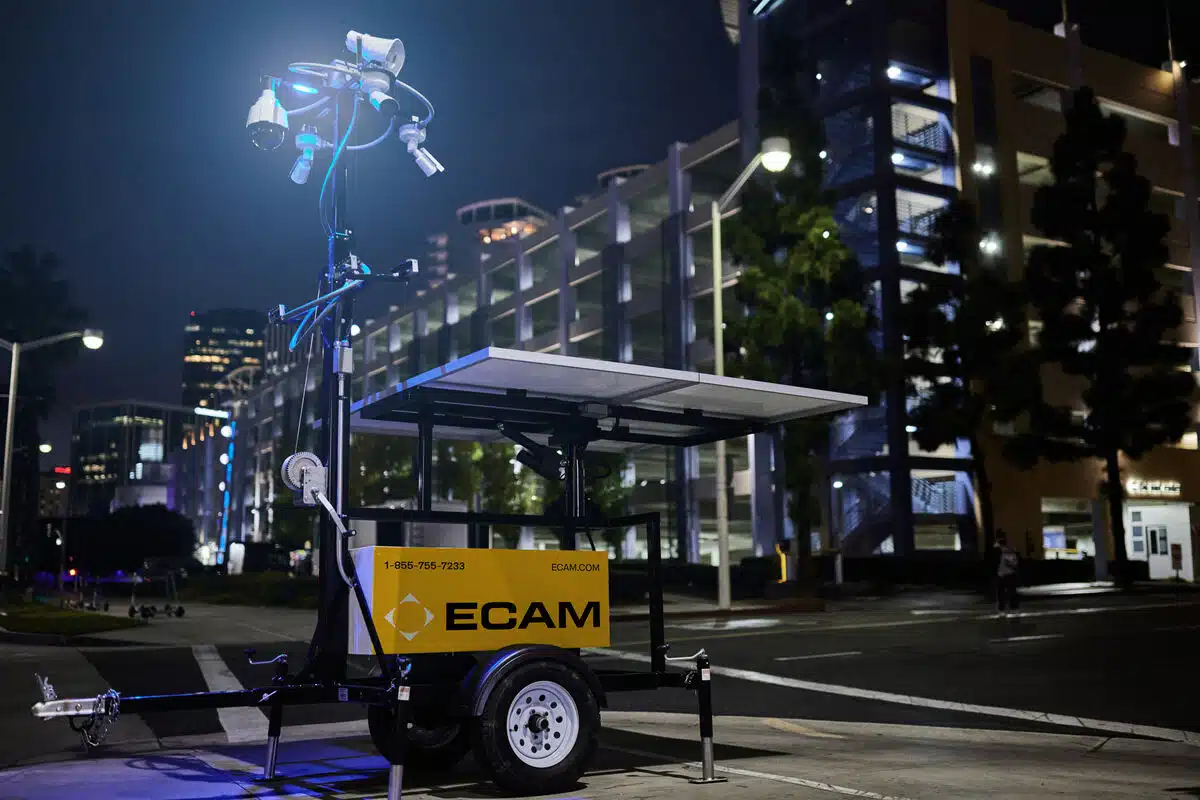


A mobile surveillance tower arrives at a large commercial property. The unit is positioned in an open area, its cameras are elevated, and the system begins providing surveillance coverage across the site.
From a distance, the deployment looks complete.
But a closer look reveals something important. Parked trailers obstruct part of the view. Valuable equipment sits behind a temporary structure. The main vehicle entrance is visible, but a secondary access route remains difficult to monitor.
The tower is operating as intended. The problem is where it’s positioned.
This illustrates one of the most important considerations when deploying a mobile surveillance tower: installing the equipment and establishing effective security coverage aren’t necessarily the same thing.
Elevated cameras, mobile power infrastructure, intelligent detection, and professional monitoring can provide valuable security capabilities. But their effectiveness depends on how those capabilities are applied to the property’s layout, operating conditions, and specific risks.
The objective isn’t simply to see as much of the property as possible. It’s to make sure the surveillance system provides useful visibility where security concerns are most likely to arise.
What Does a Mobile Surveillance Tower Actually Provide?
A mobile surveillance tower is a relocatable security platform designed to provide elevated camera coverage without requiring the same permanent infrastructure as a traditional fixed surveillance installation.
Depending on its configuration, a mobile security camera tower may include high-definition cameras, telescoping or elevated mounting equipment, lighting, independent power options, wireless connectivity, video analytics, and audible deterrence capabilities.
These technologies make mobile surveillance particularly useful for properties where permanent camera installation is impractical or where security requirements change over time.
For example, a construction site may need surveillance before permanent electrical infrastructure is available. A distribution center may require coverage around a temporary trailer storage area. A retail property may need additional visibility across an overflow parking lot.
In each case, the ability to deploy surveillance equipment without extensive permanent construction offers practical advantages.
Mobile surveillance units are available in different configurations to accommodate varying site requirements. Depending on the model, capabilities may include solar and battery power, generator support, cellular connectivity, multiple camera options, AI-assisted detection, and live audio intervention.
But the equipment itself is only part of the security solution.
A tower’s elevated position can help extend visibility across an outdoor environment. The cameras provide the video. Analytics help identify relevant activity, and trained monitoring professionals can review events and initiate appropriate responses when warranted.
Each capability contributes to the overall system.
Still, even a sophisticated surveillance tower can provide limited value if its cameras aren’t directed toward the areas that matter most.
Seeing More Isn’t Necessarily Seeing What Matters
Height is one of the most recognizable characteristics of a mobile CCTV tower.
By elevating cameras above ground level, these systems can provide broader views of outdoor properties and help reduce certain obstructions that would affect cameras mounted closer to the ground.
That’s useful, particularly across large parking areas, industrial yards, construction sites, and other open environments.
But a broader field of view doesn’t automatically translate into better security coverage.
Consider a camera positioned to overlook an entire commercial parking lot.
From its elevated position, it may capture vehicles moving through the property and people walking between parking areas.
However, the same wide view may not provide sufficient detail to evaluate activity around a specific entrance, equipment storage location, or restricted area.
Viewing distance, camera resolution, lens configuration, lighting, and environmental conditions all affect the amount of useful visual information available.
A camera may detect movement across a large area without providing enough detail to determine what is happening.
Similarly, an elevated vantage point may improve visibility over some obstacles while leaving other areas obscured by buildings, parked trailers, large equipment, or vegetation.
This is why surveillance design should begin with the security objective rather than the maximum theoretical viewing range.
A system intended to monitor unauthorized access to a construction equipment yard may require a different camera configuration and placement from one intended to provide broader situational awareness across a parking lot.
Both applications may benefit from a mobile surveillance tower.
But the right location for one may not be the right location for the other.
Effective surveillance isn’t determined by how far a camera can see. It’s determined by whether the camera provides useful visibility into the activity that matters.
Three Questions That Should Determine Tower Placement
Before deploying a security camera tower, businesses should understand what needs protection, how relevant activity may develop, and which environmental factors could limit surveillance.
Three questions can help guide that evaluation.
1. What Are We Trying to Protect?
Every property has different security priorities.
At a construction site, valuable equipment, stored materials, and temporary access points may represent significant areas of exposure.
At an automotive dealership, the concern may involve outdoor vehicle inventory, service areas, or remote storage lots.
At an industrial facility, outdoor equipment, inventory, and restricted yard areas may require attention.
These priorities should influence the surveillance strategy before the tower is positioned.
For example, placing a unit near the center of a large property might provide broad visual coverage. But if the most important security concern involves unauthorized access to a specific storage area, a different position may offer more useful visibility.
The objective is to align camera coverage with the assets and activities that create meaningful security risk.
2. Where Could Relevant Activity Occur?
Understanding how people and vehicles move through a property is essential to selecting an effective tower location.
This includes identifying established entrances, service roads, access restrictions, vehicle routes, and areas where unauthorized activity may occur.
A surveillance tower positioned near a vehicle entrance may provide useful visibility into arriving and departing traffic.
A unit overlooking equipment storage may be better suited to detecting people approaching valuable assets.
A tower near the perimeter may support monitoring of a restricted boundary or another defined security area.
The appropriate placement depends on what the business expects the system to identify.
This doesn’t mean predicting exactly where an incident will occur.
It means understanding the property’s layout and known exposures well enough to make informed decisions about coverage.
3. What Could Limit the View?
Camera placement should also account for the environment surrounding the tower.
Buildings, containers, parked vehicles, construction materials, vegetation, and other structures can create visual obstructions.
Nighttime lighting and weather conditions can influence image quality. Changes in vehicle parking patterns or equipment storage may also affect previously unobstructed views.
In some locations, the tower’s physical footprint, ground conditions, or proximity to vehicle traffic may limit where it can safely be deployed.
A professional site assessment can help identify these considerations before installation.
The goal is to avoid discovering coverage limitations only after a security incident reveals them.
One Property Can Have Several Correct Tower Locations
Imagine a commercial property with a large outdoor parking area, a warehouse, an equipment storage yard, and a vehicle entrance.
The business decides to deploy a mobile surveillance tower.
Where should it go?
There isn’t necessarily one correct answer without first understanding the security objective.
If the primary concern is activity across the parking lot, positioning the tower to overlook vehicle parking and pedestrian movement may provide the most useful coverage.
If valuable equipment has been stored in a restricted outdoor yard, the tower may be better positioned to observe approaches to that area.
If unauthorized vehicle access is the primary concern, coverage around the entrance or another relevant access point may take priority.
The property hasn’t changed.
The equipment may be identical.
But the intended security outcome changes the most appropriate deployment location.
This illustrates why the placement of a parking lot surveillance tower, construction security tower, or industrial surveillance unit shouldn’t be based exclusively on where the equipment is easiest to park.
A centrally located tower isn’t automatically the most effective choice.
Nor is the highest possible camera position necessarily the best configuration for every application.
In some circumstances, more than one camera position or surveillance unit may be needed to address separate areas of exposure.
In others, an existing fixed camera system may provide suitable coverage of one portion of the property while a mobile unit supplements another.
The best deployment strategy accounts for the available infrastructure, relevant risks, and visual information needed to support monitoring.
What Happens After the Tower Detects Activity?
A mobile surveillance tower can provide an elevated view of a property, but capturing video is only one part of an effective security operation.
Consider a person approaching a restricted outdoor storage area after the business has closed.
If the surveillance system is designed only to record footage, the activity may be documented for later investigation.
With professional live video monitoring, AI-assisted analytics can help identify activity that meets predefined detection criteria and surface the event for review.
A trained monitoring professional can evaluate the footage and determine whether the activity warrants attention under the property’s established procedures.
If intervention is appropriate, the operator may initiate an onsite audio warning, notify designated personnel, continue observing the situation, or escalate the event according to the service agreement and available capabilities.
The process connects camera visibility to a defined security response.
But here’s where tower placement becomes especially important.
A monitoring professional can only evaluate the visual information available to them.
If a camera provides a clear view of the restricted area, the operator may have useful information for assessing the activity.
If equipment obstructs the view or the camera is positioned too far away to provide adequate detail, verification may be more difficult.
This is why tower placement and monitoring strategy shouldn’t be treated as unrelated decisions.
The surveillance design needs to support the information required for effective event review.
Similarly, detection settings and response procedures should reflect the property’s actual conditions.
A person approaching a construction equipment yard after hours may warrant review, while an authorized employee working in the same area during scheduled operations may be engaged in routine activity.
Professional verification helps distinguish between those situations without treating every detected movement as proof of a security threat.
A mobile surveillance tower becomes more valuable when its cameras, analytics, monitoring personnel, and response procedures are configured around the same security objectives.
Mobility Matters After Deployment, Not Just Before It
One of the greatest advantages of a mobile surveillance tower is that it can be relocated when security requirements change.
That benefit is often discussed in terms of initial deployment.
A mobile unit can provide coverage where permanent camera infrastructure isn’t available, helping businesses address temporary or emerging security needs.
But the flexibility remains valuable after the tower has been installed.
Consider an active construction site.
During early work, valuable equipment may be concentrated in one staging area. As construction progresses, that equipment may move to another part of the property.
New structures can also change what existing cameras can see.
A tower that provided useful surveillance during the first phase may no longer be positioned to address the most important security exposures during the next.
The same principle applies to logistics facilities where trailers are frequently rearranged, automotive dealerships managing overflow inventory, and commercial properties introducing temporary outdoor storage.
A mobile unit creates an opportunity to adjust coverage as those conditions evolve.
However, mobility doesn’t mean that every new location is automatically suitable.
Repositioning may require reassessing ground conditions, power availability, cellular connectivity, camera angles, obstructions, and the security priorities of the new location.
Monitoring configurations and site instructions may also need to be updated.
For example, a restricted area that was previously within a camera’s view may no longer be covered after the tower moves.
Relocation should therefore be treated as a security design decision rather than simply moving equipment from one parking space to another.
The advantage of mobile surveillance isn’t just that the tower can move. It’s that the security strategy can adapt when the property changes.
Where Mobile Surveillance Towers Make the Most Sense
Different industries have different reasons for deploying mobile surveillance.
The common factor is the need for flexible coverage where permanent security infrastructure may be insufficient, unavailable, or impractical.
Construction Sites
Active construction projects often require security before permanent power and networking are installed.
Equipment storage, temporary access routes, and staging locations can also change as work progresses.
Mobile surveillance units can help support construction jobsite security by providing relocatable coverage around relevant areas without requiring an entirely permanent installation.
As the project evolves, the surveillance strategy can be reviewed and adjusted to reflect new exposures.
Energy and Utility Sites
Energy infrastructure often extends across remote or unmanned locations, including substations, transmission corridors, and utility construction sites.
These properties can present security challenges involving copper theft, vandalism, unauthorized access, and limited onsite personnel. Permanent power and network connectivity may also be unavailable or impractical, particularly during construction or temporary maintenance projects.
Mobile surveillance towers can provide flexible coverage around critical equipment, restricted access points, and temporary work areas. Depending on their configuration, independent power options, cellular connectivity, AI-assisted detection, and professional remote monitoring can help support security operations at locations without conventional infrastructure.
For energy and utility facilities, the ability to deploy and reposition surveillance as site conditions change can be especially valuable when protecting distributed assets across large geographic areas.
Commercial Parking Lots
Large parking areas can present challenges involving vehicle theft, vandalism, unauthorized activity, and limited visibility.
A parking lot surveillance tower may provide supplemental coverage in locations where fixed camera infrastructure is incomplete or where temporary parking arrangements create additional security needs.
The appropriate position depends on the property’s layout, vehicle access, pedestrian movement, and areas where suspicious activity requires attention.
Industrial and Logistics Properties
Industrial yards and logistics facilities often have large outdoor areas containing equipment, vehicles, trailers, and stored materials.
These environments may also experience changing storage arrangements or temporary increases in inventory.
A mobile security camera tower can provide additional visibility where fixed cameras don’t adequately cover current operating conditions.
For example, a temporary trailer storage area may require surveillance before the business is prepared to invest in permanent infrastructure.
Automotive Dealerships and Remote Storage Lots
Auto Dealerships may store vehicles across multiple properties, including temporary overflow lots and secondary storage areas.
These locations don’t always have the same security infrastructure as the main dealership.
A mobile surveillance tower can provide flexible coverage around valuable inventory, particularly where permanent cameras, power, or connectivity aren’t readily available.
Across these applications, the same principle applies.
The best mobile surveillance deployment is the one designed around the property’s specific security risks rather than a generic assumption about coverage.
What to Evaluate Before Deploying a Mobile Security Camera Tower
Businesses comparing mobile surveillance towers should look beyond mast height, camera count, or equipment appearance.
Those specifications can be important, but they don’t independently determine how well the system will address the property’s security needs.
A more useful evaluation considers the complete deployment.
| Evaluation Area | What to Consider |
| Security objective | Which assets, locations, or activities require surveillance? |
| Tower placement | Where can the unit provide useful visibility into those areas? |
| Camera performance | Are viewing distance, fields of view, image quality, and low-light capabilities appropriate? |
| Power and connectivity | Does the configuration support the site’s operating conditions and infrastructure limitations? |
| AI-assisted detection | What activity can the system identify, and how are relevant events selected for review? |
| Professional monitoring | Who verifies potential threats, and what response procedures are available? |
| Changing site conditions | How will coverage be reassessed as equipment, vehicles, or access routes move? |
| Installation and support | Who handles deployment, configuration, maintenance, and potential repositioning? |
These considerations help distinguish a complete mobile security solution from an equipment-only deployment.
A property may have sufficient camera technology but need better placement.
Another may need a different camera configuration to address viewing distance or nighttime conditions.
A third may benefit from professional monitoring and response capabilities that go beyond recording footage.
And some properties may require multiple units or a combination of fixed and mobile surveillance to achieve appropriate coverage.
The right decision depends on what needs protection and how the surveillance system will be operated.
The Best Tower Location Is the One That Supports the Security Objective
A mobile surveillance tower provides businesses with a practical way to establish elevated security coverage without relying entirely on permanent infrastructure.
Its mobility can be especially valuable for construction sites, parking areas, industrial properties, and outdoor locations where security requirements change.
But the benefits of a surveillance tower aren’t determined by height or portability alone.
Camera placement influences what can be seen.
Image quality and environmental conditions influence how effectively activity can be evaluated.
AI-assisted analytics help identify events that may warrant attention.
Trained monitoring professionals provide verification, while established response procedures determine what happens when suspicious activity requires intervention.
And as the property changes, the surveillance strategy may need to change with it.
These capabilities are most effective when they’re designed to support the same security objectives.
A tower positioned to provide a broad view of a property may offer valuable situational awareness. But if the business’s most significant exposure is hidden behind a structure or outside the useful viewing area, that deployment may need to be reconsidered.
The objective isn’t simply to place a visible security tower onsite.
It’s to position and configure the system so it provides meaningful visibility into the activities and locations that matter most.
A mobile surveillance tower can see far. The real measure of its effectiveness is whether it’s watching the right place.
Put Mobile Surveillance Where It Matters Most
A mobile surveillance tower should do more than stand above your property. ECAM helps businesses identify appropriate coverage locations and deploy mobile surveillance units with AI-assisted detection, professional remote video monitoring, and ongoing field support. Speak with an ECAM expert about a mobile security solution designed around your site’s risks and operating conditions.
Build a Stronger Security Strategy

Download Security Guides
Practical ebooks to help you strengthen your security and solve your challenges.

Discover Industry Security Solutions
See how ECAM protects your industry with solutions designed to deter crime, reduce losses, and keep operations moving.


