


How AI Governance Is Becoming a Critical Part of Enterprise Security Strategy
Artificial intelligence is transforming how organizations operate.
From automating workflows and optimizing supply chains to supporting security operations and business intelligence, AI is becoming deeply embedded in day-to-day decision-making. Yet as organizations accelerate adoption, many executive teams are discovering that governance is not keeping pace with innovation.
For years, enterprise security has been viewed through separate lenses: cybersecurity, physical security, and operational risk. Today, those boundaries are disappearing.
AI-enabled systems now influence digital infrastructure, physical environments, logistics operations, workforce management, and critical business processes. As these technologies become more autonomous, organizations need a governance strategy that provides visibility across every layer of the enterprise—not just the network.
The Growing Disconnect Between Leadership and Operational Reality
Recent industry research points to a growing gap between executive confidence and operational readiness when it comes to AI governance.
Many executive teams believe their organizations have the controls necessary to manage AI-related risks. Meanwhile, technical and operational teams often report that important governance frameworks, monitoring capabilities, and oversight processes are still evolving.
This disconnect creates a significant challenge.
When leadership assumes protections exist that operational teams know are incomplete, organizations develop blind spots that can increase exposure to fraud, insider threats, operational disruption, and security incidents.
The issue is no longer whether AI introduces new risks.
It is whether organizations have the visibility to manage them effectively.
Why AI Security Risks Extend Beyond Cybersecurity
Much of the conversation around AI security focuses on cyber threats such as data leakage, phishing, or malicious code.
While these concerns are important, AI is also changing the physical side of enterprise security.
Today, AI-enabled systems influence:
- Facility access
- Gate operations
- Logistics workflows
- Manufacturing environments
- Distribution centers
- Critical infrastructure
- Autonomous operational processes
As digital and physical systems become increasingly interconnected, organizations must view security through a broader lens.
An AI-generated phishing attack that enables unauthorized facility access.
A compromised vendor credential used to manipulate gate operations.
An automated workflow that bypasses established security procedures.
These are no longer isolated risks.
They are examples of converged security challenges that require coordinated oversight.
The Governance Gap Is Becoming a Business Risk
Many organizations continue to view AI implementation as primarily a technology initiative.
In reality, AI governance is becoming an enterprise-wide business responsibility.
Without clear governance, organizations may lack:
- Defined AI oversight policies
- Cross-functional security coordination
- Real-time operational visibility
- Standardized incident response procedures
- Accountability for AI-assisted decisions
As AI capabilities expand, these governance gaps can increase operational risk while making it more difficult to demonstrate compliance, accountability, and responsible decision-making.
Why Physical Security Belongs in the Boardroom
For many years, physical security was viewed primarily as a facilities function.
That perspective is changing rapidly.
As organizations automate operations across data centers, logistics facilities, manufacturing plants, transportation networks, and critical infrastructure, physical security has become an essential component of enterprise risk management.
Today’s security leaders must protect not only digital assets, but also the physical environments where those assets operate.
That requires visibility into:
- Access control
- Perimeter activity
- Logistics operations
- Workforce movement
- Facility operations
- Incident response
Without real-time operational awareness, organizations cannot fully understand how AI-enabled processes are affecting business risk.
Why Human Oversight Remains Essential
Artificial intelligence excels at processing large volumes of information quickly.
What it cannot consistently provide is judgment.
Human oversight remains essential for:
- Validating suspicious activity
- Understanding operational context
- Escalating incidents appropriately
- Applying organizational policies
- Maintaining accountability
Organizations adopting AI successfully are not removing people from security operations.
They are using AI to help security professionals make faster, more informed decisions.
This human-guided approach improves both operational effectiveness and organizational confidence.
How ECAM Helps Close the Executive Visibility Gap
As organizations adopt more automation, maintaining visibility across physical operations becomes increasingly important.
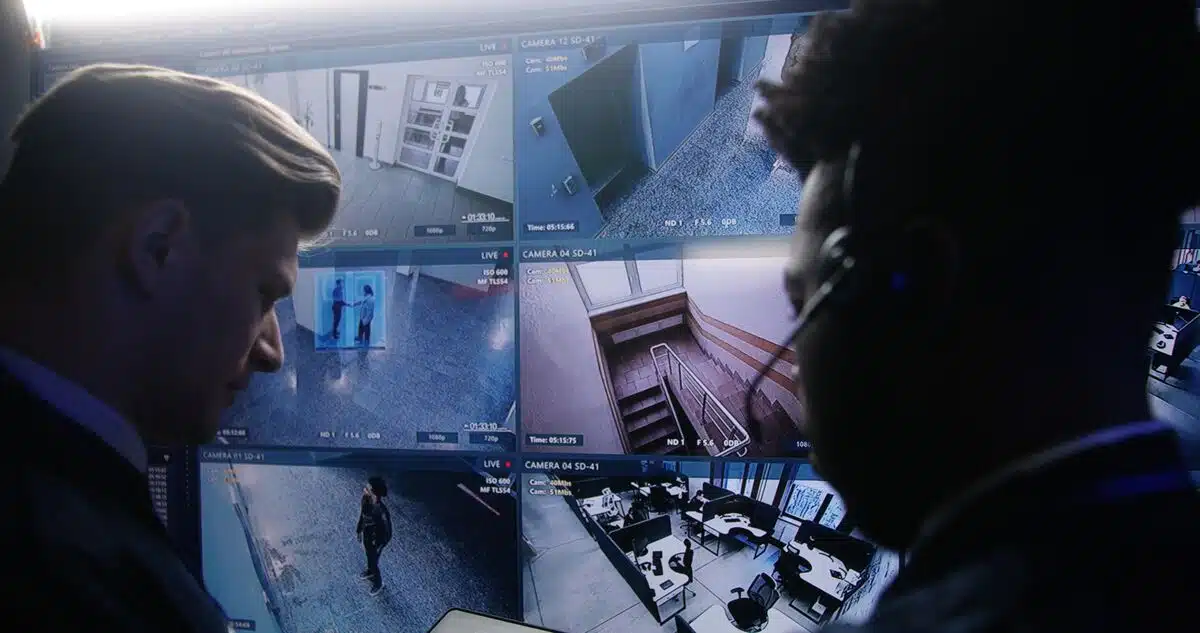
ECAM helps organizations strengthen operational oversight by combining AI-driven analytics with live monitoring and centralized security intelligence.
Real-Time Human Verification
ECAM combines intelligent detection with trained monitoring professionals who validate events before escalation occurs.
This human-in-the-loop approach helps organizations improve accuracy while reducing unnecessary responses and strengthening accountability.
Centralized Operational Visibility
ECAM provides organizations with greater visibility across distributed operations, including:
- Facility monitoring
- Gate operations
- Logistics activity
- Perimeter protection
- Video intelligence
- Incident response
By centralizing security operations, organizations gain a more complete understanding of risk across multiple locations.
Supporting Converged Security
Modern enterprise risk management requires coordination between cybersecurity, physical security, operational technology, and workforce safety.
ECAM strengthens the physical layer of that strategy by providing real-time intelligence that complements broader governance initiatives.
Improving Accountability
As organizations rely more heavily on AI-assisted operations, documenting security decisions becomes increasingly important.
ECAM supports stronger accountability through:
- Video verification
- Documented monitoring workflows
- Time-stamped incident records
- Consistent escalation procedures
- Audit-ready reporting
These capabilities help organizations demonstrate how security decisions were made while supporting compliance, investigations, and risk management.
The Future of Enterprise Security Requires AI Governance
Organizations that deploy AI without corresponding governance create unnecessary operational risk.
The organizations best positioned for long-term success will balance innovation with oversight by:
- Maintaining operational visibility
- Strengthening accountability
- Integrating human oversight
- Connecting physical and digital security
- Building resilient governance frameworks
AI will continue to transform enterprise operations.
The organizations that benefit most will be those that ensure governance evolves alongside the technology.
Why Executive Visibility Matters
Enterprise security is no longer confined to cybersecurity or physical protection alone.
It has become a business-wide governance challenge that requires visibility across people, technology, facilities, and operations.
Organizations that combine AI with centralized oversight, operational intelligence, and human expertise will be better equipped to reduce risk, improve resilience, and make more informed decisions in an increasingly automated world.
Because as AI continues to reshape enterprise operations, leadership’s greatest advantage will not be deploying more technology.
It will be having the visibility and governance to use that technology responsibly.