



A commercial property can have cameras on every corner, controlled entry points, and even on-site personnel, and still experience incidents. That is often where the disconnect becomes clear.
Security systems are in place, but they are not working together in a way that prevents problems. Activity is recorded, access is managed in certain areas, but incidents still occur in parking lots, vacant spaces, and entry points where visibility or response is limited. For property managers, this creates a familiar situation. Security exists, but it does not fully align with how risk actually shows up on the property.
Understanding commercial property security systems requires looking beyond individual components and focusing on how those systems function as a complete solution. The goal is not simply to install equipment, but to create coverage that actively reduces incidents, supports tenant confidence, and operates within real budget constraints.
What Makes a Commercial Property Security System Effective
Most commercial properties already have some level of infrastructure in place. Cameras are installed, access points are controlled, and in some cases, guards are present. Despite that, gaps remain. The difference between a system that exists and a system that performs according to commercial property security best practices comes down to three factors.
First, coverage must align with risk. Incidents tend to occur in predictable areas such as parking lots, garages, storefronts, and vacant units. Systems that are evenly distributed across a property often miss these high-risk zones.
Second, visibility must be paired with response. Cameras alone provide awareness, but without monitoring, they do not prevent incidents. Real-time oversight is what turns visibility into action.
Third, the system must be adaptable. Commercial properties change constantly. Tenants move in and out, spaces become vacant, and risk levels shift. Security needs to adjust without requiring a full rebuild each time conditions change.
When these three elements are in place, a security system becomes more than a collection of tools. It becomes a working strategy.
Commercial Property Security Cameras
Security cameras are the foundation of most commercial property security systems. They provide visibility across the property and are typically deployed in areas such as:
- Parking lots and garages
- Entrances and exits
- Loading docks and service areas
- Common areas and corridors
From a cost perspective, cameras are often one of the more attractive options because they provide continuous coverage without ongoing labor costs. This makes them a standard component across office and retail environments. However, cameras on their own have clear limitations. They record what happens, but they do not intervene. In many cases, footage is only reviewed after an incident has occurred, which means the system is functioning as documentation rather than prevention.
This is where many properties fall short. Coverage exists, but outcomes do not improve. For cameras to be effective, they need to be positioned strategically around high-risk areas and integrated into a broader system that includes monitoring and response.
Live Monitoring and Real-Time Response
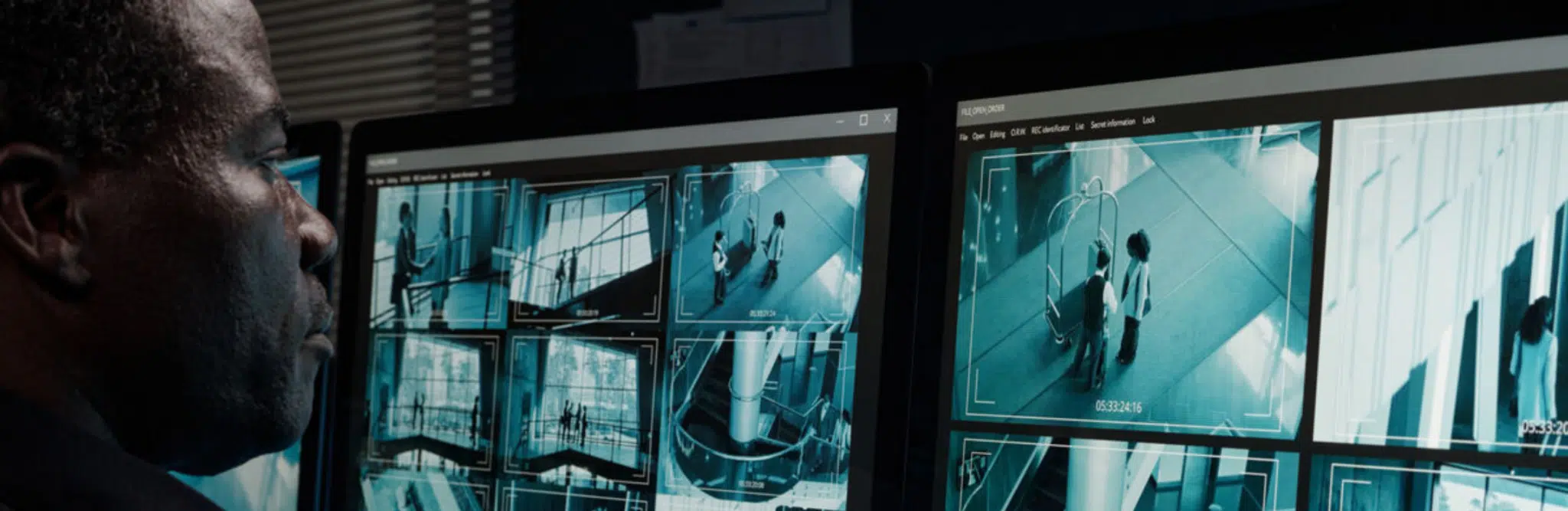
Live monitoring is what transforms a passive system into an active one. Instead of relying on recorded footage, monitoring introduces real-time visibility and response. Activity can be observed as it happens, and action can be taken before a situation escalates. This may include identifying suspicious behavior, issuing audio warnings, or escalating incidents when necessary.
For commercial properties, this is a significant shift. It allows security to move from a reactive model, where incidents are reviewed after the fact, to a proactive model, where incidents are interrupted or prevented entirely.
Monitoring also changes how resources are allocated. Rather than relying solely on physical presence, properties can achieve broader coverage across multiple areas without increasing labor costs. This is particularly valuable in environments where risk is spread across large exterior spaces such as parking lots or across multiple buildings within a portfolio.
Mobile Surveillance and Flexible Deployment
One of the most practical developments in commercial property security systems is the use of mobile surveillance. Unlike fixed systems, mobile units can be deployed quickly, repositioned as needed, and used to address changing conditions across a property. This is especially relevant in commercial real estate, where vacancy levels fluctuate and risk is not static.
Mobile surveillance is commonly used to secure:
- Parking lots and exterior areas
- Vacant buildings and suites
- Transitional spaces where permanent infrastructure is not practical
A significant portion of demand in commercial real estate is driven by these flexible solutions because they allow properties to add coverage without long-term commitments or large upfront investment.
This flexibility is not just operational. It is financial. It allows property managers to align security spend with current conditions rather than locking into fixed costs.
Access Control Systems
Access control plays a supporting but important role in commercial property security systems. It is primarily used to manage who can enter specific areas, such as:
- Office buildings and tenant spaces
- Restricted areas within a property
- Controlled entry points
In office environments, access control is often a standard requirement, particularly in buildings with multiple tenants or shared spaces. However, access control has limitations when used on its own. It manages authorized entry, but it does not address activity outside controlled zones. Parking lots, exterior areas, and vacant spaces remain vulnerable without additional visibility and monitoring.
For this reason, access control is most effective when integrated with surveillance and monitoring systems that provide coverage beyond entry points.
How to Combine Systems for Better Outcomes
The most effective commercial property security systems are not built around a single solution. They combine multiple elements into a layered approach. Cameras provide visibility across the property. Monitoring adds the ability to respond in real time. Mobile solutions introduce flexibility, allowing coverage to adapt as conditions change. Access control manages entry into key areas. When these elements are aligned, the result is a system that not only covers the property, but actively reduces risk.
This approach also supports cost efficiency. By focusing coverage on high-risk areas and using monitoring to extend visibility, properties can reduce reliance on high-cost guard coverage while maintaining or improving protection.
Choosing the Right Commercial Property Security Systems
Selecting the right system is not just a technical decision. It is an operational one. Property managers need to consider how security will function day to day, how it will adapt over time, and how it will impact both cost and performance.
A few key considerations help guide this decision.
Coverage should be aligned with where incidents actually occur, not distributed evenly across the property. Monitoring should be included to ensure that activity can be addressed in real time. Flexibility should be built in so that the system can adapt to vacancy, tenant turnover, and changing risk levels.
Scalability is also important, particularly for portfolios with multiple properties. A system that can be deployed consistently across locations creates operational efficiency and simplifies management.
Finally, integration matters. Systems that operate under a single provider and a unified platform tend to deliver better coordination, faster response, and clearer accountability.
Final Thoughts
Commercial property security systems are often evaluated based on the number of components in place. Cameras, access control, and other technologies are visible and measurable.
The more important question is how those components work together.
A system that provides visibility without response will struggle to prevent incidents. A system that cannot adapt to changing conditions will create gaps over time. A system that does not align with cost constraints will be difficult to sustain. The most effective approach is one that combines visibility, response, and flexibility into a cohesive strategy that reflects how commercial properties actually operate.
Build a Security System That Matches How Your Property Operates
Every property has a different risk profile, and security systems should reflect that.
A structured evaluation can help determine whether current systems are aligned with high-risk areas, whether monitoring is being used effectively, and where adjustments can improve both coverage and cost efficiency.
Schedule a free commercial property security assessment to get a clear view of how your current systems are performing and where improvements can be made to better support your property or portfolio.
Build a Stronger Security Strategy

Download Security Guides
Practical ebooks to help you strengthen your security and solve your challenges.

Discover Industry Security Solutions
See how ECAM protects your industry with solutions designed to deter crime, reduce losses, and keep operations moving.