


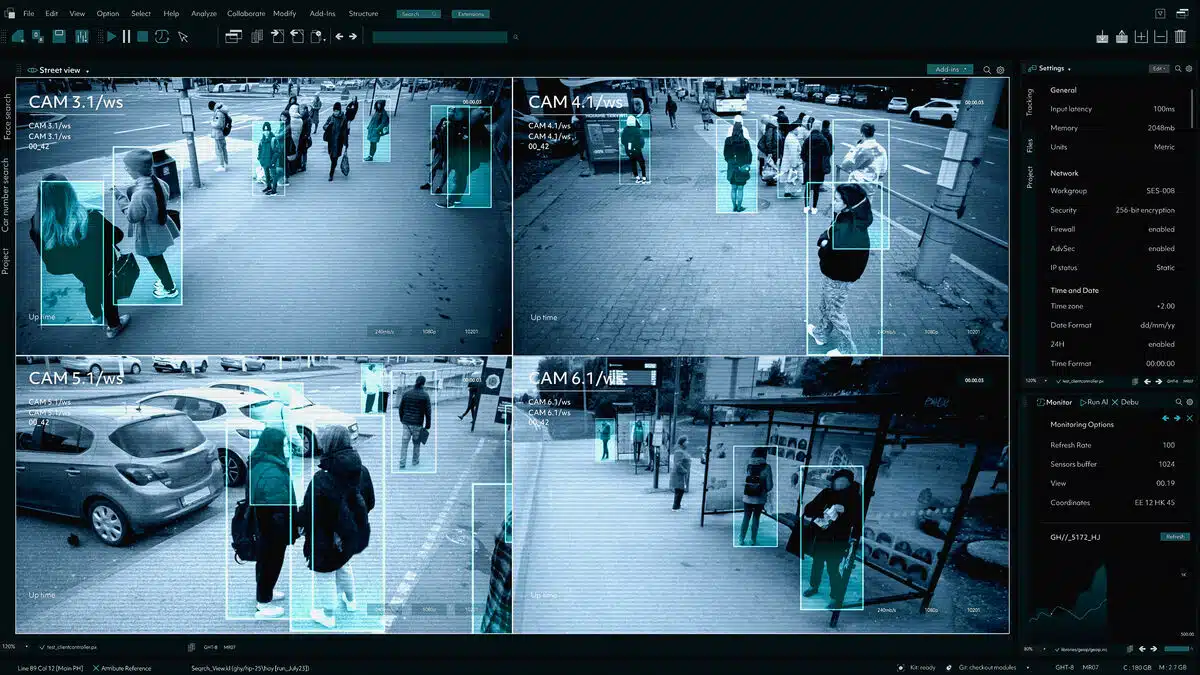


A vehicle enters a commercial property after hours. Someone walks along the perimeter of a building. An employee accesses a restricted area outside their normal schedule. A delivery driver remains parked longer than expected.
Each activity may trigger a security notification. Cameras capture footage, analytics identify movement, and alerts are generated according to the system’s settings.
But how many of those events actually require attention?
For businesses managing commercial properties, industrial facilities, or multiple locations, the challenge isn’t always a lack of security information. Modern surveillance technology can produce a steady stream of video, alerts, and notifications. The challenge is determining which information matters and what should happen next.
That’s where the effectiveness of security monitoring systems becomes apparent.
A system that detects activity provides awareness. A system that helps distinguish relevant security concerns from routine activity, supports professional verification, and connects those findings to appropriate response procedures provides something more valuable.
The goal isn’t necessarily to collect more information. It’s to make better use of the information already available.
The Problem With a Security System That Notices Everything
Security technology has become increasingly capable of identifying activity across commercial environments.
Video analytics can detect people or vehicles in designated areas. Cameras can capture activity throughout a property. Monitoring platforms can generate notifications when predefined conditions are met.
These capabilities help businesses maintain visibility across locations that would otherwise be difficult to observe continuously.
But detection creates a new responsibility: deciding which events deserve attention.
Consider a commercial facility with several monitored entrances, an outdoor storage area, and a parking lot.
During a typical day, employees arrive and leave, contractors access designated areas, deliveries occur, and vehicles move throughout the property.
A security system may identify many of these activities.
That doesn’t mean each one represents a security concern.
If every detected movement produces the same level of urgency, the business risks treating routine activity and genuinely concerning behavior as equally important.
The problem isn’t necessarily that the technology is malfunctioning. It may be doing exactly what it was configured to do.
The larger question is whether the monitoring process can distinguish information that simply documents activity from information that requires a security decision.
Effective monitoring should help direct attention toward relevant events rather than expecting every notification to receive the same response.
What Should Security Monitoring Systems Actually Do?
Security monitoring systems encompass a range of technologies and services, from basic surveillance equipment that generates notifications to professionally monitored solutions that support verification and response.
Not every system offers the same capabilities.
A standalone camera system may record footage and notify a user when motion is detected. A more advanced surveillance platform may use analytics to identify specific types of activity. A professionally monitored solution can introduce trained personnel who review relevant events and follow established procedures when intervention is warranted.
Understanding those differences begins with three fundamental functions.
| Function | What It Provides | Why It Matters |
| Detection | Identifies activity or conditions that meet predefined criteria | Helps surface events that may require attention |
| Interpretation | Evaluates relevant activity using available video, context, and site-specific procedures | Helps distinguish routine behavior from potential security concerns |
| Decision support | Provides information and established procedures for determining appropriate next steps | Connects verified events to a defined security response |
These functions are related, but they aren’t interchangeable.
Detection technology can identify that a person entered a monitored area. It doesn’t automatically establish whether that person is authorized or whether their presence represents a threat.
That determination may require additional information, professional judgment, and an understanding of the property’s operating conditions.
Similarly, a verified event doesn’t automatically determine what response should occur.
That decision depends on established protocols, the nature of the activity, and the capabilities available at the site.
A well-designed security monitoring system connects these functions rather than treating the initial alert as the end of the process.
An Alert Is Information, Not a Conclusion
Imagine a surveillance camera detects a vehicle entering an industrial yard late at night.
The detection may be accurate. A vehicle entered the monitored area.
But what does that information establish?
The vehicle could belong to an authorized carrier arriving for a scheduled pickup. It could be an employee returning equipment. It could also be an unauthorized vehicle entering an area where access is restricted.
The detection itself doesn’t resolve those possibilities.
The same challenge applies to people moving around commercial properties.
An individual approaching a building after hours might be a maintenance contractor, an employee, or someone attempting unauthorized access.
An alert can identify activity worth reviewing, but it isn’t necessarily evidence that a security incident is occurring.
This distinction is particularly important as businesses adopt more AI-assisted security capabilities.
Video analytics can help identify people, vehicles, and activity that meets configured detection criteria. More sophisticated applications can support filtering and prioritization based on defined conditions.
But identifying an event and understanding its significance are different responsibilities.
In a professionally monitored environment, trained personnel review relevant footage to determine whether the activity warrants attention.
That review may involve examining the individual’s behavior, the location involved, the time of the event, and the property’s monitoring instructions.
The goal isn’t to eliminate every uncertain situation. It’s to make decisions using more information than the initial detection alone can provide.
For businesses evaluating a security monitoring service, understanding how potential threats are verified is just as important as understanding how alerts are generated.
Why Context Changes the Meaning of Security Activity
Security risks don’t exist independently of the environment around them.
The same activity can carry different implications depending on where it occurs and how the property operates.
Consider four commercial environments.
A logistics facility: Trucks may arrive throughout the night, and trailers may be repositioned outside standard business hours. Vehicle activity alone isn’t necessarily suspicious. Unauthorized access to a restricted trailer storage area, however, may warrant review.
A construction site: Work schedules, authorized personnel, and restricted areas can change as the project progresses. Monitoring procedures need to reflect current site conditions rather than assumptions established months earlier.
A commercial office: Employee access may be concentrated during normal business hours, but cleaning crews, maintenance personnel, and authorized staff can legitimately enter after hours.
A retail property: Pedestrian and vehicle activity may remain common after individual stores close, particularly when restaurants, entertainment businesses, or shared parking areas operate on different schedules.
In each environment, the effectiveness of security monitoring depends partly on understanding what activity is expected.
That understanding doesn’t come from cameras alone.
It comes from how monitoring procedures are configured, how site information is maintained, and how trained professionals evaluate relevant events.
This also explains why security monitoring shouldn’t be treated as a one-time technology installation.
As a business changes its operating hours, expands facilities, introduces new access points, or modifies restricted areas, its monitoring requirements may change as well.
A security monitoring system should reflect the environment it’s protecting.
Otherwise, the business risks generating unnecessary alerts or overlooking activity that deserves closer attention.
What Does Smart Monitoring Actually Mean?
The term smart monitoring is frequently used to describe modern security technology, but it doesn’t always refer to the same capabilities.
For some systems, it means automated notifications delivered to a mobile device.
For others, it refers to video analytics, remote camera access, or software that can identify certain types of activity.
Those capabilities can be useful, but automation alone doesn’t necessarily produce a more effective security operation.
A notification that reaches someone’s phone faster still requires someone to determine what it means.
An analytics platform that identifies relevant activity still needs an appropriate process for evaluating the event.
And even a verified security concern needs a defined response.
Within a professionally monitored security program, intelligent technology and human expertise serve complementary roles.
AI-assisted detection helps identify activity that meets established criteria. That can help monitoring professionals focus on events that are more likely to require review rather than continuously observing every camera feed.
Trained personnel then evaluate the available video and determine whether the situation warrants action under site-specific procedures.
Depending on the system and the event, those procedures may include continued observation, an audible warning, notifying designated contacts, or escalating verified activity.
The value of smart monitoring isn’t simply that more of the process is automated.
It’s that technology supports more focused professional attention, while human judgment remains part of the verification and response process.
A smarter monitoring operation doesn’t necessarily generate more alerts. It helps make the alerts that matter more useful.
The Events That Matter Most Aren’t Always the Most Obvious
Some security events are straightforward to identify.
A person climbing a secured fence or attempting to enter a locked storage area may present an obvious concern.
Other situations are less clear.
An individual walking through a parking lot may be engaged in normal activity. Someone repeatedly approaching parked vehicles and checking door handles may warrant closer attention.
A truck entering a distribution yard may be expected. A vehicle moving into a restricted portion of the property may deserve additional review.
A person standing near a commercial entrance may be waiting for someone. Repeated attempts to access a secured door outside authorized hours present a different situation.
These examples illustrate why security decisions often depend on more than a single detected movement.
Location, behavior, operating conditions, and available visual information can all influence whether activity deserves attention.
That doesn’t mean a security monitoring system can reliably determine criminal intent or predict every incident.
It means that appropriately configured detection technology, combined with professional review, can help identify and assess activity that might otherwise go unnoticed until after an incident.
This is particularly valuable across large commercial properties where employees cannot reasonably observe every monitored area.
The objective is to support informed security decisions without treating every unusual movement as proof of wrongdoing.
Security Monitoring Is an Operational Responsibility, Not Just a Technology
It’s easy to evaluate security monitoring through a list of technical capabilities.
How many cameras can the system support? What can the analytics detect? How quickly can notifications be delivered? Can users access footage remotely?
These are important considerations.
But they don’t fully explain how the security operation functions.
A monitoring program also depends on responsibilities, procedures, communication, and maintenance.
Who reviews events when activity is detected?
What information is available to help determine whether an event is concerning?
Which situations require escalation?
Who should be contacted when an incident is verified?
What happens when designated contacts are unavailable?
How are incidents documented?
Who addresses equipment failures or connectivity issues?
The answers help establish whether the system can perform consistently once it’s deployed.
Site-Specific Procedures Provide Direction
A commercial property should have monitoring instructions that reflect its security requirements.
These may identify restricted areas, expected operating conditions, authorized activities, designated contacts, and appropriate escalation procedures.
Without those instructions, even trained monitoring personnel may lack important information needed to evaluate an event.
Reliable Infrastructure Supports Reliable Monitoring
The cameras, network connections, recording infrastructure, and monitoring technology must also function as intended.
Poor camera positioning, connectivity problems, equipment failures, or inadequate nighttime visibility can limit the information available during an event.
Monitoring effectiveness therefore depends partly on proper installation, system maintenance, and ongoing technical support.
Security Procedures Need to Evolve
A property may introduce new operating hours, modify access arrangements, or change how certain areas are used.
When those changes affect security expectations, monitoring procedures may need to be updated.
A process designed around outdated site conditions can make otherwise useful technology less effective.
This is one reason businesses should consider the full operational model when selecting a monitoring provider.
Design, installation, integration, monitoring, maintenance, and response procedures are interconnected responsibilities.
Coordinating them can help create a more consistent security operation than treating every component as an unrelated service.
How to Evaluate a Security Monitoring System
Choosing a monitoring security system requires looking beyond individual features to understand how the solution works in practice.
A system with advanced analytics may still be a poor fit if it cannot provide useful camera coverage or if the business lacks a reliable process for responding to relevant events.
Likewise, a professional monitoring service should be evaluated on more than the availability of trained personnel.
The technology, procedures, and support model all matter.
| Evaluation Area | What Businesses Should Understand |
| Detection capabilities | What types of activity can the system identify, and what are its limitations? |
| Alert configuration | How are detection criteria established, and how are relevant events selected for review? |
| Professional verification | Who evaluates potential threats, and what information is available to support that assessment? |
| Property-specific context | How are operating schedules, restricted areas, and site instructions incorporated? |
| Response procedures | What actions are authorized when concerning activity is verified? |
| Existing infrastructure | Can the solution integrate with compatible cameras and security equipment already installed? |
| System reliability | How are equipment issues, connectivity problems, and other technical concerns addressed? |
| Ongoing support | Who maintains the system and helps update procedures as the property’s needs change? |
These considerations become especially important when comparing basic alert-based security products with professionally monitored solutions.
A system that sends notifications to an internal contact may be appropriate for some businesses.
Others may benefit from trained monitoring professionals who review relevant activity and initiate defined response procedures.
The appropriate approach depends on the property’s risks, operating requirements, internal resources, and expectations for security response.
Rather than beginning with the number of cameras or the sophistication of the analytics, businesses should determine how they want relevant security information to be handled.
That decision provides a more useful foundation for selecting the technology and services that support it.
Better Security Doesn’t Start With More Alerts
Commercial properties don’t necessarily need security systems that produce more information.
They need relevant information to reach the right people, with enough context to support appropriate decisions.
That requires more than cameras, analytics, or notifications operating independently.
It requires detection technology configured around the property’s security requirements, professional verification when warranted, and established procedures that define what happens next.
It also requires ongoing attention to the infrastructure and site conditions that influence monitoring effectiveness.
When those elements work together, security monitoring becomes less about collecting events and more about identifying which events deserve action.
For businesses protecting people, property, equipment, and operations, that distinction matters.
The purpose of a security monitoring system isn’t to notice everything and treat every event as an emergency.
It’s to help ensure that meaningful security concerns receive appropriate attention, informed evaluation, and a defined response.
Make Your Security Information More Actionable
Your property may already have cameras and security technology generating valuable information. The next step is making sure relevant activity receives the attention it deserves. ECAM combines intelligent detection, professional remote video monitoring, and established response procedures to help businesses identify and address potential security concerns. Speak with an ECAM expert about strengthening your security monitoring strategy.
Build a Stronger Security Strategy

Download Security Guides
Practical ebooks to help you strengthen your security and solve your challenges.

Discover Industry Security Solutions
See how ECAM protects your industry with solutions designed to deter crime, reduce losses, and keep operations moving.


