




Smart Buildings Are Not the Future Anymore, They Are the Standard
Picture walking into a modern commercial building. Doors unlock automatically. HVAC adjusts based on occupancy. Lighting responds to daylight conditions. Security feeds are live, data-rich and always on.
Everything works, but only because everything is connected.
That is the new reality of smart building integration. Buildings are no longer defined by standalone systems like cameras, access control or automation. They are defined by how intelligently those systems work together to improve safety, efficiency and decision-making.
As adoption accelerates and IoT ecosystems scale, one question becomes unavoidable for building owners, operators and enterprise leaders:
How do you turn connected devices into intelligent outcomes?
That is where ECAM becomes more than a monitoring provider. ECAM becomes a trusted partner in the smart building ecosystem.
Why Smart Building Integration Is Accelerating
Smart buildings are growing rapidly because organizations are facing growing expectations in three areas:
Operational efficiency
Facility teams are under pressure to reduce downtime, streamline workflows and manage more assets with fewer resources.
Sustainability and ESG reporting
Energy performance and sustainability initiatives are no longer optional for many organizations. Smart buildings support measurable energy efficiency through automation, optimization and data visibility.
Safety and security
Organizations want proactive protection, faster response and fewer operational disruptions caused by false alarms and reactive processes.
Smart technologies help deliver all three, but only when integration is done right.
The Challenge: Connected Devices Do Not Automatically Create Intelligence
Smart building environments generate enormous volumes of real-time data. Cameras, access control systems, sensors, HVAC, lighting and building management platforms all contribute signals.
The problem is not a lack of data. The problem is what happens next.
If those systems are not unified, contextualized and operationalized, buildings end up with:
- fragmented workflows
- too many alerts and too little clarity
- slow response paths
- limited ability to scale across sites
- increasing integration complexity over time
The real goal of smart building integration is not simply connectivity. It is coordinated intelligence.
This is where ECAM delivers value by turning real-time inputs into actionable outcomes.
Intelligent Security Is a Core Smart Building Function
Security is no longer a standalone “system in the corner.” In smart buildings, security becomes one of the most important operational layers because it intersects with people, assets and business continuity.
ECAM supports smart building integration by helping organizations:
- apply AI-driven detection and video analytics
- verify threats before escalation
- reduce unnecessary alerts and dispatches
- support faster response through edge-enabled intelligence
- integrate with access control, IoT networks and building systems
Moving Beyond Motion: AI Security That Adds Context
Traditional security monitoring often relies on motion detection, which creates a common operational problem: false alarms.
The next generation of smart building security relies on AI security that understands what matters. Instead of triggering alerts for every movement, intelligent detection focuses on real risk indicators such as:
- people and vehicles in unauthorized areas
- suspicious behavior patterns
- policy violations and access anomalies
- potential threats in sensitive locations
This approach brings smart buildings closer to what they were designed to be: environments that learn, respond and improve.
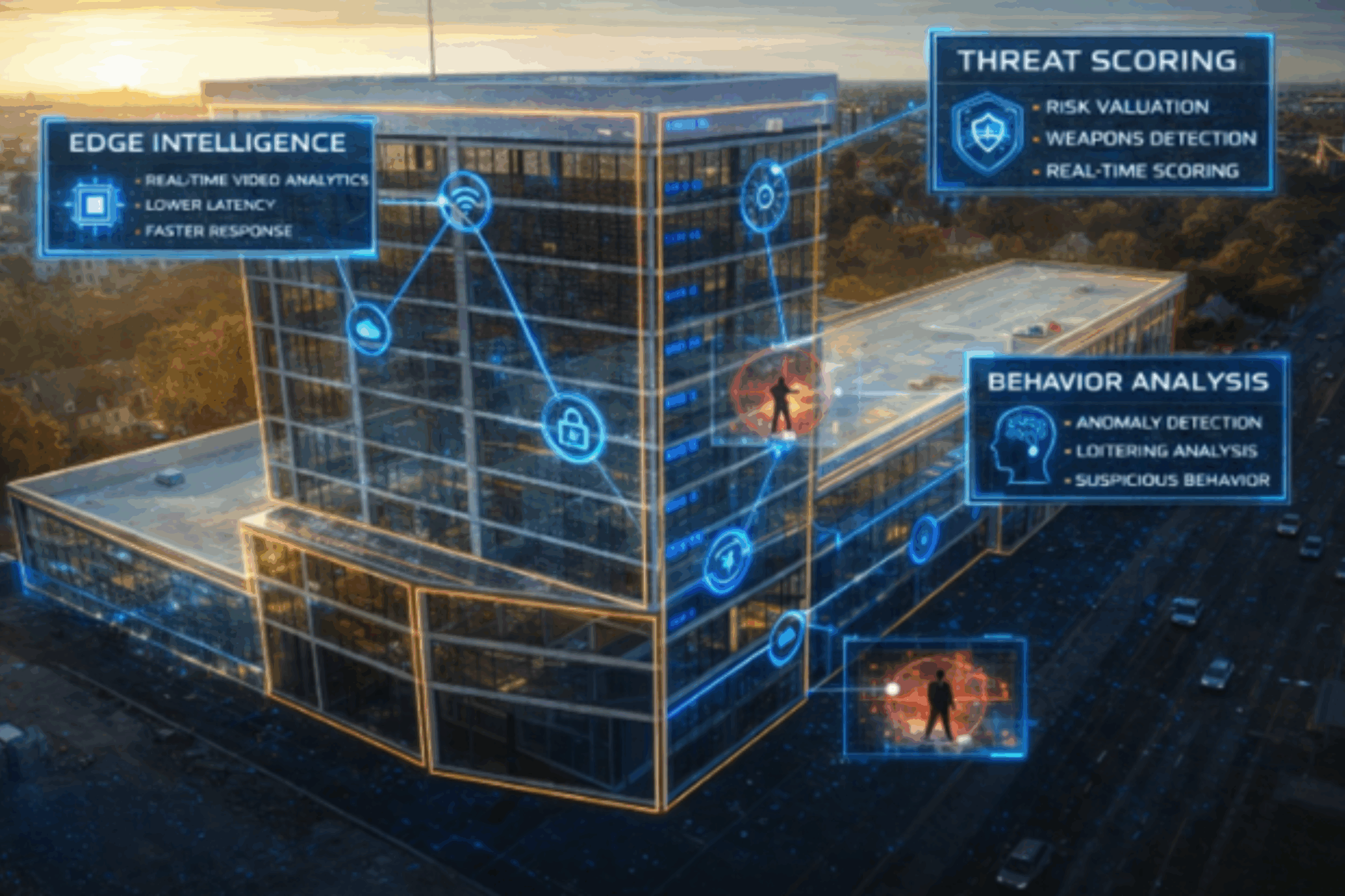
Weapons Detection, Threat Scoring, and Behavioral Analysis: Smarter Risk Decisions
As buildings become more populated and dynamic, enterprise leaders want more than visibility. They want security systems that interpret risk and prioritize action.
This is where advanced capabilities like these become critical:
Weapons detection
Weapons detection supports earlier identification of high-risk scenarios, helping teams respond faster and more effectively without waiting for an incident to escalate.
Threat scoring and risk valuation
Not every alert is equal. Smart building security must prioritize response based on severity. Threat scoring evaluates multiple factors such as:
- object recognition
- behavioral indicators
- location sensitivity
- time, access permissions and movement patterns
This allows teams to focus response where it matters most.
Behavioral analysis
Behavioral analytics add context by identifying potential anomalies like:
- loitering
- tailgating
- erratic movement
- deviations from typical patterns
When integrated into a smart building environment, behavioral analysis supports early intervention and reduces false alarms.
Together, these tools help shift security from reactive monitoring to predictive protection.
How Security Supports ESG, Efficiency, and Smarter Operations
Smart building leaders increasingly view security as part of a broader performance strategy, not just a protective requirement.
ECAM complements energy and sustainability initiatives by supporting:
- fewer unnecessary dispatches through verified events
- reduced reliance on fuel-based patrol models
- smarter incident handling that minimizes disruption
- data-driven insight that supports compliance and reporting efforts
Security becomes an operational contributor rather than a cost center.
Edge Intelligence and Predictive Protection at Scale
Smart building ecosystems are moving toward edge computing and predictive intelligence because it supports faster decisions and reduced strain on networks.
ECAM applies these same principles to security by:
- processing video and sensor data closer to the source
- escalating only verified threats
- enabling real-time intervention
- reducing noise for facilities and IT teams
- supporting predictive identification of emerging risk trends
In smart buildings, speed and clarity are the difference between an alert and an avoided incident.
Secure, Interoperable, and Built for Enterprise Scale
Smart buildings are only as strong as the systems that connect them. As IoT ecosystems grow, so does the risk surface. That makes cybersecurity, data governance and interoperability non-negotiable requirements.
ECAM is designed to operate in complex environments by supporting:
- multi-vendor and legacy system integration
- secure access controls and data handling
- alignment with enterprise IT and operational frameworks
- scalable deployments across portfolios and regions
This ensures smart building integration can scale without compromising operational continuity or security posture.
Final Thoughts: Smart Building Integration Requires the Right Partner
Smart buildings are not defined by the number of devices deployed. They are defined by how intelligently systems operate together to protect people, support efficiency and reduce risk. As the connected building landscape grows, organizations will increasingly rely on partners who can unify technology, data and real-time human judgment.
That is what ECAM delivers through advanced AI security, real-time verified intervention, and integrated intelligent monitoring built for modern environments.
Plan the Next Phase of Smart Building Integration with ECAM
If your organization is investing in smart building integration, your security strategy should evolve with it. ECAM helps enterprise teams modernize building security through AI-driven detection, real-time remote monitoring and intelligent integration across connected systems.
Build a Stronger Security Strategy

Download Security Guides
Practical ebooks to help you strengthen your security and solve your challenges.

Discover Industry Security Solutions
See how ECAM protects your industry with solutions designed to deter crime, reduce losses, and keep operations moving.