
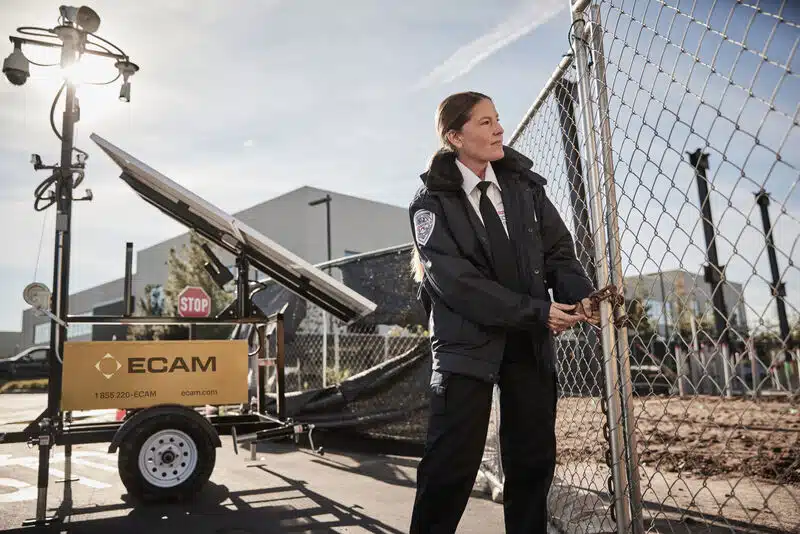



Most security systems are designed to respond after someone is already on site.
An alarm is triggered. A camera captures footage. A report is filed. By that point, the perimeter has already been crossed, and whatever happens next unfolds inside the property.
Perimeter security systems are built around a different objective.
Instead of focusing on what happens within a site, they are designed to detect and address activity at the boundary, before an individual gains access to the space itself. This shift, from internal response to external detection, is what defines effective perimeter protection.
Why the Perimeter Is the Most Critical Line of Defense
Every property has a boundary, whether it is clearly defined by fencing and gates or simply implied by the layout of a parking lot, yard, or open space.
That boundary is where intent becomes visible.
Inside a building or active environment, it can be difficult to distinguish between normal and suspicious behavior. At the perimeter, however, the act of entering or crossing into a restricted area is often the first clear signal that something may be wrong.
Despite this, many security strategies place limited emphasis on perimeter zones. Cameras may be focused on entrances or interior spaces, leaving the outer edge of the property less actively monitored.
This creates a delay.
By the time activity is detected, the individual has already moved beyond the point where early intervention is possible.
The Limitations of Traditional Perimeter Security
Traditional approaches to perimeter security have typically relied on a combination of:
- Physical barriers such as fencing or gates
- Motion sensors that trigger alerts
- Static camera coverage along the property edge
While these measures provide a baseline level of protection, they often lack precision and context.
Motion-based alerts can be triggered by environmental factors such as wind, animals, or passing vehicles. Static cameras may record activity without distinguishing whether it represents a real threat.
Over time, this can lead to alert fatigue or delayed response, where signals are either ignored or acted upon too late.
The challenge is not detection alone. It is meaningful detection.
What Video Analytics for Perimeter Security Adds
Video analytics for perimeter security introduces a more intelligent layer of detection.
Rather than simply identifying motion, these systems analyze movement patterns, object types, and behavior within defined zones. This allows the system to distinguish between normal environmental activity and events that require attention.
For example, video analytics can:
- Detect when a person crosses a virtual perimeter line
- Identify movement in restricted areas during specific time windows
- Differentiate between vehicles, people, and background motion
- Focus attention on activity that aligns with defined risk scenarios
For those asking what is video analytics for perimeter security?, it is the capability that allows a system to interpret what it sees, not just capture it.
From Detection to Proactive Perimeter Protection
Detection becomes significantly more effective when it is paired with action.
Proactive video analytics for perimeter security enables remote video monitoring teams to respond to activity as it occurs, rather than after the fact. When a potential intrusion is identified, that response may include:
- Verifying the activity in real time
- Issuing a verbal warning before access is gained
- Escalating to security personnel or authorities
- Documenting the event as it unfolds
This approach changes the outcome.
Instead of managing incidents inside the property, organizations have the opportunity to deter or interrupt activity at the perimeter itself.
Applying Perimeter Security Across Different Environments
While perimeter security systems are often associated with high-security facilities, the same principles apply across a wide range of environments.
Parking lot security systems, for example, benefit from clearly defined perimeter zones that help identify when individuals enter areas during off-hours or move in ways that fall outside normal patterns.
Industrial sites, logistics yards, and commercial properties all face similar challenges at their boundaries, particularly in areas where access is open or loosely controlled.
Even in environments without physical barriers, virtual perimeters created through camera placement and analytics can establish a clear line of detection.
Building a Perimeter That Works as an Active System
Effective perimeter security is not defined by a single component.
It is built through the combination of:
- Clearly defined physical or virtual boundaries
- Camera placement that supports full perimeter visibility
- Video analytics that interpret activity within those zones
- Monitoring capabilities that enable timely response
When these elements are aligned, the perimeter becomes an active system rather than a passive boundary.
The earlier you detect a problem, the more options you have to stop it.
Perimeter security systems are most effective when they focus on the boundary, not just the interior.
If you’re evaluating how your current system handles perimeter activity, it may be worth looking at how early detection is actually happening.
Speak with an expert to explore how video analytics can strengthen your perimeter security strategy.
Build a Stronger Security Strategy

Download Security Guides
Practical ebooks to help you strengthen your security and solve your challenges.

Discover Industry Security Solutions
See how ECAM protects your industry with solutions designed to deter crime, reduce losses, and keep operations moving.