


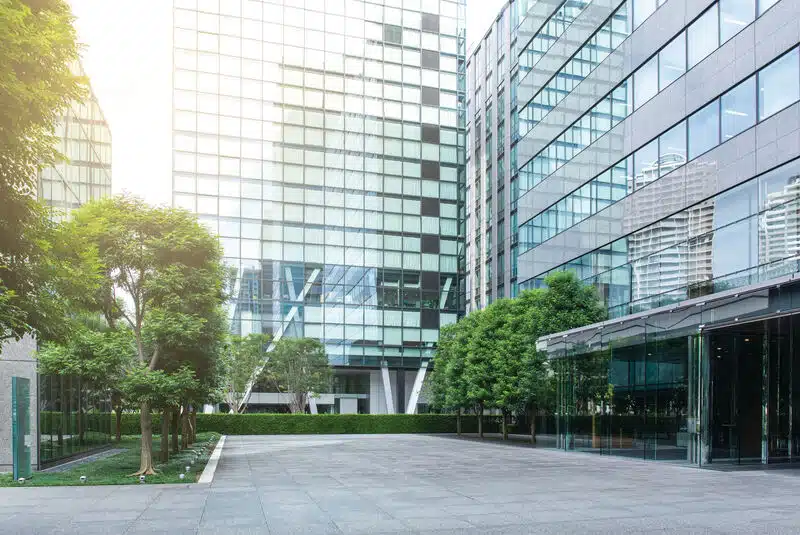



In many office buildings today, the biggest security risks are not happening during business hours.
They happen after hours, in empty suites, parking structures, and common areas where activity is limited and visibility is low.
A property can appear fully secure during the day, with tenants in place and operations running normally, while at night it becomes significantly more vulnerable. Vacant spaces, in particular, create ideal conditions for unauthorized entry, theft, and damage that may not be discovered until days later.
For property managers, this creates a persistent challenge. Security needs to extend beyond occupied hours and actively protect the parts of the building that are most exposed.
This is where office building remote video monitoring has become a critical part of modern commercial property security.
Why Office Buildings Require a Different Security Approach
Office properties operate differently from retail environments, and the risks reflect that.
Vacancy is one of the most significant drivers of security issues. Empty suites provide access points for unauthorized entry, and once inside, the damage can escalate quickly. Copper theft from HVAC systems, removal of piping, and vandalism are common outcomes, and these incidents often result in substantial repair costs and extended downtime.
At the same time, many of the highest-risk areas in office buildings are outside of controlled interior spaces.
Parking lots, garages, and building entrances are consistently where incidents occur. These areas are difficult to secure with traditional methods alone, especially across larger properties or multi-building campuses.
This combination of vacancy-driven risk and exposure across exterior zones makes it difficult for static or limited security systems to perform effectively.
A different approach is required, one that provides visibility across the entire property and the ability to respond when activity occurs.
What Is Office Building Remote Video Monitoring
Office building remote video monitoring refers to a commercial security system where cameras across the property are actively observed by trained operators in real time.
Unlike traditional surveillance, where footage is reviewed after an incident, remote monitoring introduces immediate awareness and response.
When activity is detected, monitoring teams can:
- Identify behavior that may indicate a potential issue
- Issue live audio warnings to deter unwanted activity
- Escalate situations when necessary
This allows incidents to be interrupted before they result in damage or loss.
The difference is not just in how the system operates, but in the outcome it produces. Instead of documenting incidents, it actively works to prevent them.
How Remote Video Monitoring Works in Practice
To understand the value of remote video monitoring, it helps to look at how it functions in a real-world office environment.
Cameras are positioned across high-risk areas of the property, including parking lots, garages, entrances, and vacant spaces. These cameras feed into a monitoring center where activity is reviewed continuously.
When motion or unusual behavior is detected, it is filtered and prioritized so that monitoring teams can focus on relevant events rather than background activity. This reduces noise and improves response time.
If an issue is identified, operators can intervene immediately. In many cases, a live audio warning is enough to deter unauthorized individuals before they escalate their actions. If the situation continues, it can be escalated further based on predefined protocols.
This process is designed to be proactive. The goal is to stop incidents before they become costly events rather than responding after the fact.
Why Monitoring Is More Effective Than Passive Surveillance
Many office buildings already have cameras in place, but those systems are often passive.
They provide visibility, but only after something has already occurred.
This creates a gap between coverage and outcome.
Remote video monitoring closes that gap by introducing real-time response. Instead of relying on footage to understand what happened, the system actively works to influence what happens next.
This is particularly important in environments where incidents can escalate quickly. A break-in that goes unnoticed for hours or days can result in extensive damage. A monitored system has the ability to interrupt that sequence early.
It also changes how resources are used. Instead of relying solely on physical presence, which can be limited and costly, monitoring extends visibility across multiple areas simultaneously.
The Role of Mobile Surveillance in Office Environments
Office buildings often require security solutions that can adapt to changing conditions.
Vacancy levels shift, tenants move in and out, and certain areas of the property may become higher risk over time.
Mobile surveillance plays an important role in addressing these challenges.
These systems can be deployed quickly to cover vacant buildings, parking lots, or areas where additional visibility is needed. They do not require permanent infrastructure, which makes them particularly useful for temporary or evolving situations.
A significant portion of demand in commercial real estate is driven by these flexible solutions because they allow properties to respond to risk without long-term commitments.
When combined with remote monitoring, mobile surveillance provides both visibility and response, creating a more complete security solution.
Where Remote Monitoring Has the Greatest Impact
While remote video monitoring can be applied across an entire property, there are specific areas where it consistently delivers the most value.
Parking lots and garages are among the highest-risk zones due to limited visibility and lower levels of control. Monitoring these areas helps deter unauthorized activity and improves overall safety.
Building entrances and vestibules are another key focus. These are transition points where access needs to be observed and controlled, particularly after hours.
Vacant spaces are perhaps the most critical. Without active monitoring, these areas can go unprotected for extended periods, increasing the likelihood of theft or damage.
By concentrating coverage on these locations, monitoring systems are able to deliver measurable improvements in incident prevention.
Cost Considerations and Operational Impact
For property managers, the value of remote video monitoring is closely tied to cost and operational efficiency.
Traditional approaches that rely heavily on guard coverage can be expensive and difficult to scale, especially across larger properties or multiple locations.
Monitoring provides a different model.
It allows properties to maintain visibility and response across a wider area without the same level of labor cost. This makes it possible to reduce reliance on physical coverage while maintaining, or in many cases improving, overall protection.
It also reduces the operational burden associated with incidents. Fewer break-ins, less damage, and fewer tenant complaints all contribute to a more stable and manageable environment.
This is where monitoring aligns with the broader goals of commercial property management, balancing cost control with risk reduction.
Final Thoughts
Office building remote video monitoring is not simply an upgrade to existing systems. It represents a shift in how security is approached.
Instead of relying on passive coverage or limited physical presence, monitoring introduces real-time awareness and the ability to act when it matters.
For office environments, where vacancy and after-hours exposure create significant risk, this approach provides a more effective way to protect the property, reduce incidents, and support overall operations.
Strengthen Security Where Your Office Property Is Most Exposed
Every office building has areas where risk is higher, particularly in parking structures, entrances, and vacant spaces.
A structured evaluation can help determine whether current systems are providing real-time visibility, whether monitoring is being used effectively, and where additional coverage may be needed.
A commercial property security assessment can identify gaps, improve coverage across high-risk areas, and help align your security approach with the realities of how office buildings operate today.

