
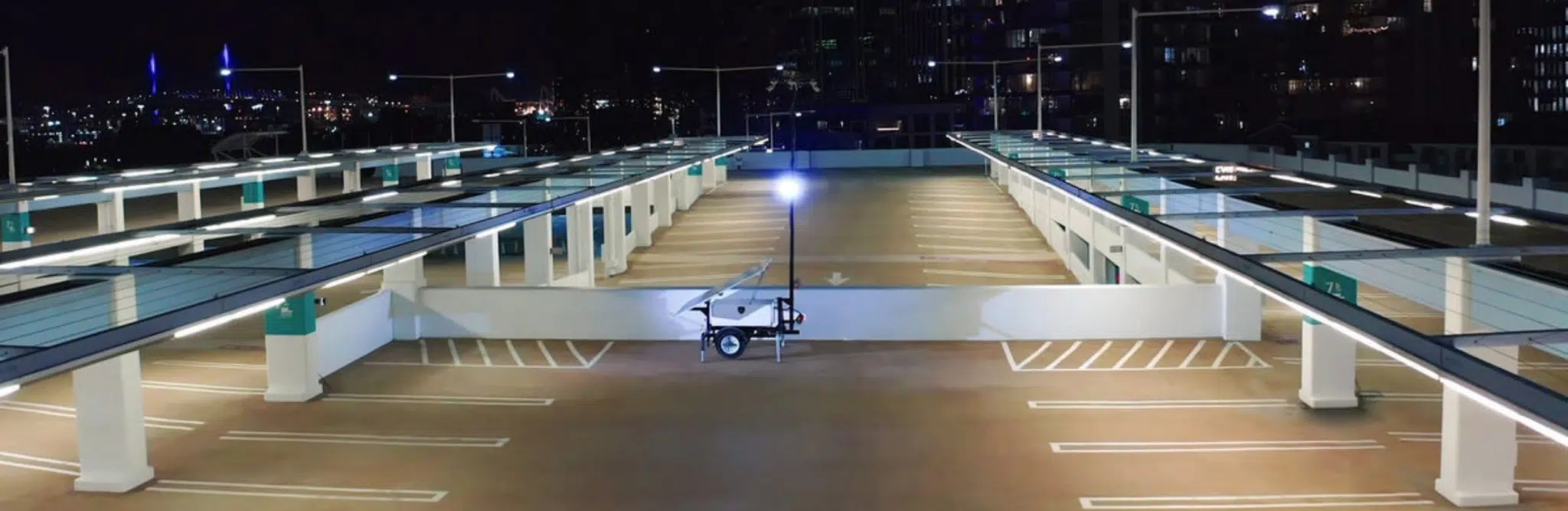



Sometimes security needs to go somewhere permanent infrastructure can’t.
A construction project moves into a new phase. Equipment is temporarily stored outside existing camera coverage. A vacant property needs protection between tenants. A parking area is being used for an event or seasonal operation. A business discovers a blind spot that needs coverage now rather than after a permanent system can be installed.
In situations like these, the search often begins with mobile security cameras.
But there’s an important difference between moving a camera and moving an entire security capability.
A camera still needs the right position. It needs power. It needs connectivity. Someone or something has to recognize relevant activity. Someone has to determine what that activity means. And when something requires attention, there needs to be a response.
That’s why mobility shouldn’t be measured simply by whether a camera can be relocated.
A truly mobile security system brings the capabilities required to detect, verify, and respond to activity wherever they’re needed.
A Camera Being Portable Doesn’t Make Security Mobile
At its simplest, a portable camera solves one problem:
You can move the camera.
That can be useful.
If an organization only needs to temporarily record activity in a small area with existing power and connectivity, a standalone portable camera may be perfectly adequate.
Commercial security requirements can become more complicated.
Imagine trying to protect a remote equipment yard.
You need a camera, but where will you mount it?
How will it be powered?
How will video be transmitted?
How much of the yard can it see?
What happens when someone enters after hours?
Who receives the alert?
Who determines whether the person belongs there?
What happens if they don’t?
Suddenly, the camera itself is only one piece of the problem.
That’s the distinction between mobile surveillance cameras and a complete mobile security strategy.
To understand the difference, it helps to build the system from the camera outward.
Layer 1: Put Visibility Where You Need It
Every security system starts with visibility.
But temporary and changing environments can make camera placement especially important.
A camera monitoring a vehicle gate has a different job from one overlooking a large equipment yard. Perimeter coverage requires different positioning from surveillance around stored materials. A construction site may need visibility in one area today and somewhere completely different several months from now.
That’s why effective mobile security cameras need to do more than relocate.
They need to be positioned around the actual security problem.
Elevated camera mounting can help provide broader views across outdoor environments, while multiple cameras can provide visibility into different areas around the deployment.
This is one reason mobile surveillance units are often designed around an elevated platform rather than simply placing a portable camera at ground level.
The value isn’t the height itself.
It’s the ability to position useful visibility where permanent infrastructure may not already exist.
Layer 2: Give the Camera the Infrastructure It Needs
Moving the camera is relatively straightforward.
Moving everything the camera depends on can be harder.
Permanent security cameras are often installed around infrastructure that already exists. Buildings provide mounting locations. Electrical systems provide power. Network infrastructure provides connectivity.
Temporary sites don’t always have those advantages.
A construction project may still be developing its permanent infrastructure. A remote portion of a property may not have power where additional coverage is needed. A temporary storage area may exist too briefly to justify installing permanent networking and electrical infrastructure.
A truly mobile camera system needs to account for those limitations.
Depending on the deployment, mobile surveillance units can incorporate power and connectivity into the system itself, reducing dependence on permanent infrastructure at the location being protected.
That makes the security capability more deployable.
Instead of asking:
Where can we install a camera based on the infrastructure we already have?
The organization can begin asking:
Where do we actually need security coverage?
That’s a much more useful starting point.
Layer 3: Detect the Activity That Matters
Once the cameras are positioned and connected, another problem appears.
Video.
Lots of it.
A camera can record hours of empty property, routine traffic, weather, animals, employees, contractors, deliveries, and other ordinary activity.
The objective isn’t to treat everything the camera sees as a security event.
It’s to identify the activity that deserves attention.
AI-assisted analytics can help a mobile security camera system identify defined activity, such as people or vehicles entering areas where they aren’t expected, and surface those events for review.
That becomes particularly valuable when mobile surveillance is deployed across large outdoor environments.
Rather than expecting someone to continuously watch every camera, technology can help direct attention toward activity that meets the criteria established for the property.
But detection still doesn’t answer the most important question:
What does the activity actually mean?
Layer 4: Decide Who’s Actually Watching
This is where the difference between a portable camera and monitored mobile security becomes much clearer.
A portable security camera system may detect activity and send an alert to someone’s phone.
That can work well when the person receiving the notification is available, sees it quickly, understands the property, and knows what to do next.
But that also leaves the responsibility for security with the customer.
Someone has to notice the notification.
Open the footage.
Determine what’s happening.
Decide whether the activity is legitimate.
And determine whether action is required.
Live video monitoring changes that model.
Instead of making a property manager, superintendent, operations leader, or other employee responsible for interpreting security alerts, trained monitoring professionals can review relevant activity as part of the security service.
They can evaluate what the cameras are showing against expected site conditions and established response procedures.
That creates an important distinction:
A portable camera lets you move where you record.
Monitored mobile security lets you move where you can detect, verify, and respond.
Layer 5: Turn Detection Into Response
Suppose a mobile surveillance system detects someone entering a protected area after hours.
The event is reviewed.
The person isn’t expected to be there.
Now what?
A complete security strategy needs an answer.
Depending on the site, available technology, and established response protocols, monitoring professionals can continue observing the event, issue a live audio warning where appropriate, contact designated personnel, or escalate verified activity to law enforcement.
The exact response should reflect the property and circumstances.
What matters is that the security process doesn’t end when the camera identifies activity.
Detection → Verification → Response
That’s when mobile cameras become part of a mobile security system rather than simply a relocatable recording device.
Temporary Security Cameras Still Need a Complete Strategy
Temporary security requirements can sometimes sound less significant than permanent ones.
They’re often anything but.
Businesses may need temporary security cameras because they’re operating under conditions that are changing quickly or don’t yet support permanent infrastructure.
That can include:
- construction projects
- renovations and expansions
- temporary equipment or material staging
- vacant properties
- temporary parking areas
- seasonal operations
- infrastructure outages
- special projects
- remote areas outside permanent camera coverage
In these environments, flexibility becomes especially valuable.
Consider a construction site.
During early phases, the greatest concern may be the perimeter and equipment stored across an open property.
Later, materials may concentrate around partially completed structures.
As buildings go vertical, new access points and blind spots emerge.
Eventually, permanent infrastructure becomes available and fixed security cameras may make more sense.
The security requirement moved even though the property never did.
A mobile surveillance system can move with those changing conditions rather than requiring every temporary need to become a permanent installation.
How Mobile Does Your Security Actually Need to Be?
Not every temporary security requirement calls for a mobile surveillance unit.
The right approach depends on what the organization actually needs the system to accomplish.
| Security Need | Potential Approach |
| Small temporary area with existing infrastructure | Portable camera |
| Short-term coverage with available power and connectivity | Relocatable camera system |
| Large outdoor area requiring broader visibility | Elevated mobile camera system |
| Site with limited permanent infrastructure | Mobile surveillance unit |
| Active verification and intervention | Mobile surveillance unit with live monitoring |
| Coverage that needs to change repeatedly | Redeployable mobile surveillance unit |
This is why starting with the camera can sometimes lead organizations toward the wrong solution.
A business that only needs temporary recording may not need an advanced monitored system.
A business protecting valuable assets across a large outdoor property may need considerably more than a portable camera.
The right question isn’t:
Which mobile camera should we buy?
It’s:
What security capability needs to move?
When a Mobile Surveillance Unit Makes Sense
A mobile surveillance unit brings many of the layers we’ve discussed together in one deployable system.
Rather than assembling a temporary security solution one component at a time, an MSU can combine cameras, elevated coverage, connectivity, intelligent detection, audio capabilities, and live monitoring.
That can make MSUs particularly useful when an organization needs security quickly in an area where installing a permanent system would be impractical, premature, or unnecessarily restrictive.
They can also supplement existing fixed systems.
A facility may have excellent permanent cameras around its buildings but lack coverage across a remote parking area.
A warehouse may need temporary surveillance around inventory stored outside.
A vacant commercial property may require additional perimeter coverage until a new tenant arrives.
A construction project may need cameras that can be repositioned as work progresses.
In each case, the MSU isn’t replacing permanent infrastructure simply because it is mobile.
It’s filling a security requirement that permanent infrastructure doesn’t currently address well.
The Best Mobile Security System Moves With the Risk
The biggest advantage of mobile surveillance isn’t that the equipment can be moved.
It’s that the security strategy can change when the environment does.
Inventory moves.
Construction progresses.
A temporary storage area opens and closes.
A vacant property becomes occupied.
Parking requirements change.
A blind spot appears.
A new phase of work creates a different perimeter.
Permanent camera systems are naturally designed around relatively stable environments.
Mobile surveillance provides another option when the environment isn’t stable.
That’s the difference between thinking about mobile security cameras as individual pieces of equipment and thinking about mobile security as a capability.
The camera has to move.
But so does everything that makes the camera useful: its position, power, connectivity, detection capabilities, monitoring, and response process.
Mobility isn’t valuable because the camera can change locations. It’s valuable because security can follow the risk.
Need Security Somewhere Permanent Infrastructure Doesn’t Fit?
Whether you’re protecting a temporary site, filling a coverage gap, or dealing with security requirements that change over time, start with what the system needs to accomplish rather than the camera itself.
Build a Stronger Security Strategy

Download Security Guides
Practical ebooks to help you strengthen your security and solve your challenges.

Discover Industry Security Solutions
See how ECAM protects your industry with solutions designed to deter crime, reduce losses, and keep operations moving.