
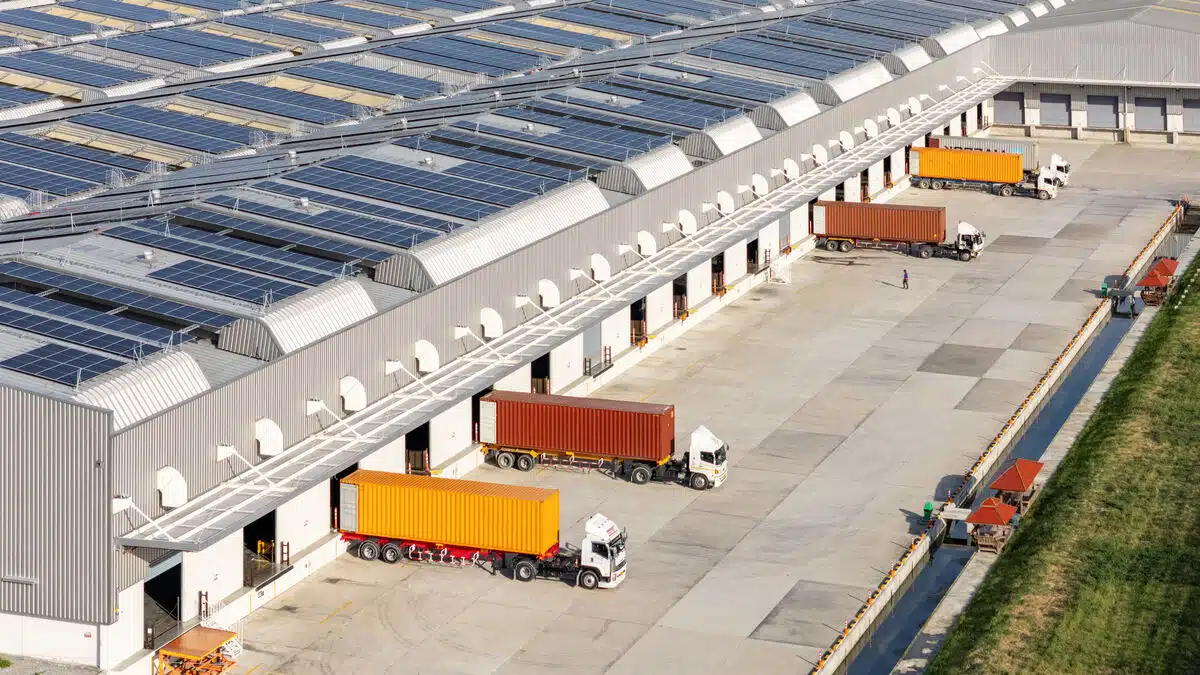



Large Yards Require More Than Traditional Security
Logistics yards face unique security challenges. High-value cargo, large outdoor footprints, frequent vehicle traffic, and around-the-clock operations create multiple opportunities for theft, trespassing, vandalism, and unauthorized access.
Traditionally, many logistics operators have relied on security guards to protect their facilities. Today, remote video monitoring has emerged as a powerful alternative that combines continuous visibility, AI-powered detection, and real-time intervention.
If you’re comparing security guards vs video monitoring for logistics yards, the real question isn’t simply which solution provides security coverage. It’s which approach is better equipped to deliver consistent protection across large, complex environments where incidents can occur anywhere at any time.
This comparison is designed for logistics operators, distribution center managers, transportation companies, and security decision-makers evaluating how to protect assets, reduce loss, and improve visibility across their yards.
Key Differences at a Glance
- Security guards provide physical presence, while video monitoring provides continuous visibility across the entire yard
- Guards can only be in one location at a time, while monitored cameras observe multiple areas simultaneously
- Video monitoring combines AI detection with real-time human intervention
- Guards may deter through visibility, while video monitoring enables active deterrence through audio warnings and escalation
- Video monitoring provides consistent coverage without patrol gaps
- Security guards require ongoing labor costs, while video monitoring offers a more scalable security model
- Video monitoring creates recorded evidence and reporting for investigations and liability protection
- Hybrid security models can combine the strengths of both approaches
Breaking Down the Differences
| Category | Security Guards | Video Monitoring |
| Coverage Model | Physical patrols and stationed personnel | Continuous monitoring across all cameras |
| Visibility | Limited to guard location and patrol timing | Full-yard visibility at all times |
| Detection | Manual observation | AI-powered detection with human verification |
| Response Model | On-site response by guards | Real-time intervention, audio deterrence, and escalation |
| Consistency | Dependent on staffing and patrol schedules | Standardized, continuous monitoring |
| Scalability | Requires additional personnel | Easily scalable across large properties |
| Documentation | Incident reports and notes | Recorded video, event logs, and reporting |
| Cost Structure | Labor-based operational expense | Technology and service-based investment |
| Best Fit | Sites requiring physical presence | Large outdoor environments requiring broad visibility |
Physical Presence vs Continuous Visibility
Security guards have long been a cornerstone of logistics yard security.
Their responsibilities often include:
- Conducting perimeter patrols
- Monitoring gates and access points
- Responding to incidents
- Verifying trailer and cargo activity
- Providing visible deterrence
For certain operational needs, physical presence remains valuable.
However, logistics yards often span large areas with multiple entrances, storage zones, parking areas, and loading locations. Even highly trained security personnel can only observe a small portion of the property at any given time.
Live video monitoring addresses this challenge differently.
Rather than relying on periodic observation, monitored cameras provide continuous visibility across the entire yard.
Modern systems can:
- Detect suspicious activity automatically
- Alert operators immediately
- Verify events in real time
- Issue live audio warnings
- Escalate incidents when necessary
This creates a security model built around comprehensive visibility rather than periodic observation.
Coverage Gaps vs Real-Time Awareness
One of the biggest challenges with patrol-based security is timing.
Incidents frequently occur:
- Between patrol rounds
- In low-visibility areas
- Across multiple locations simultaneously
For large logistics facilities, these gaps can create vulnerabilities.
Video monitoring is designed to reduce those blind spots.
With strategically positioned cameras covering the property:
- Multiple areas are monitored simultaneously
- Suspicious activity can be identified immediately
- Operators can intervene before incidents escalate
For logistics operators, where cargo theft, unauthorized access, and yard intrusions can occur quickly, the ability to detect and respond in real time can significantly impact outcomes.
Presence vs Coverage: A Simple Decision Lens
When comparing security guards vs video monitoring for logistics yards, the decision often comes down to:
Are you prioritizing physical presence or continuous yard-wide protection?
- If your priority is having personnel physically present throughout operations, security guards may be appropriate
- If your priority is maintaining continuous visibility and proactive response across the entire property, video monitoring often provides broader coverage
This distinction becomes increasingly important as yard size, inventory value, and operational complexity grow.
When a Hybrid Approach Makes Sense
For many logistics yards, security isn’t an either-or decision.
A hybrid approach that combines video monitoring with strategically deployed security personnel can provide a highly effective security model.
In this approach:
- Video monitoring provides continuous visibility across the entire property
- AI-powered detection identifies suspicious activity in real time
- Operators intervene immediately through live audio and escalation
- Security personnel focus on tasks that benefit from physical presence
This allows organizations to:
- Maintain broad, consistent coverage
- Reduce gaps between patrols
- Improve incident response
- Optimize security spending
- Deploy guards where they add the greatest value
For example, a logistics yard may use video monitoring as the primary layer of protection overnight while utilizing guards for gate operations, visitor management, incident follow-up, or daytime patrols.
In many cases, video monitoring becomes the foundation of the security strategy, while security personnel support specific operational and physical security needs.
Choosing the Right Approach for Your Logistics Yard
Both security guards and video monitoring can play an important role in protecting logistics operations.
Security guards may be a strong fit if you:
- Require physical presence at gates or checkpoints
- Need personnel for visitor management or access control
- Operate smaller facilities where patrol coverage is sufficient
- Have operational responsibilities that extend beyond security
Video monitoring may be a better fit if you:
- Need continuous visibility across large outdoor environments
- Want real-time detection and intervention
- Need to secure multiple areas simultaneously
- Are looking to reduce theft, vandalism, and unauthorized access
- Want a scalable solution across multiple locations
A hybrid approach may be the best fit if you:
- Need both continuous visibility and physical personnel
- Operate large, complex logistics facilities
- Want to maximize coverage while optimizing security costs
- Require both operational support and proactive monitoring
Two Different Approaches to Logistics Yard Security
Security guards and video monitoring both play important roles in modern logistics security, but they solve different challenges.
Security guards provide physical presence and direct interaction.
Video monitoring provides continuous visibility, proactive intervention, and scalable protection across large outdoor environments.
For many logistics operators, the strongest security strategy combines both approaches, using technology to create constant awareness while deploying personnel where they can have the greatest impact.
What’s the Next Step?
If you’re evaluating security solutions for your logistics yard, the next step is understanding how different approaches apply to your facility size, operational requirements, and risk profile.
If you want to explore how video monitoring, mobile surveillance, and proactive security strategies work together, check out our Security Technology Buyer’s Guide.
If you’re ready to evaluate a more proactive approach, you can connect with an ECAM expert to review your site and identify opportunities to improve coverage and reduce risk in real time.
Build a Stronger Security Strategy

Download Security Guides
Practical ebooks to help you strengthen your security and solve your challenges.

Discover Industry Security Solutions
See how ECAM protects your industry with solutions designed to deter crime, reduce losses, and keep operations moving.