
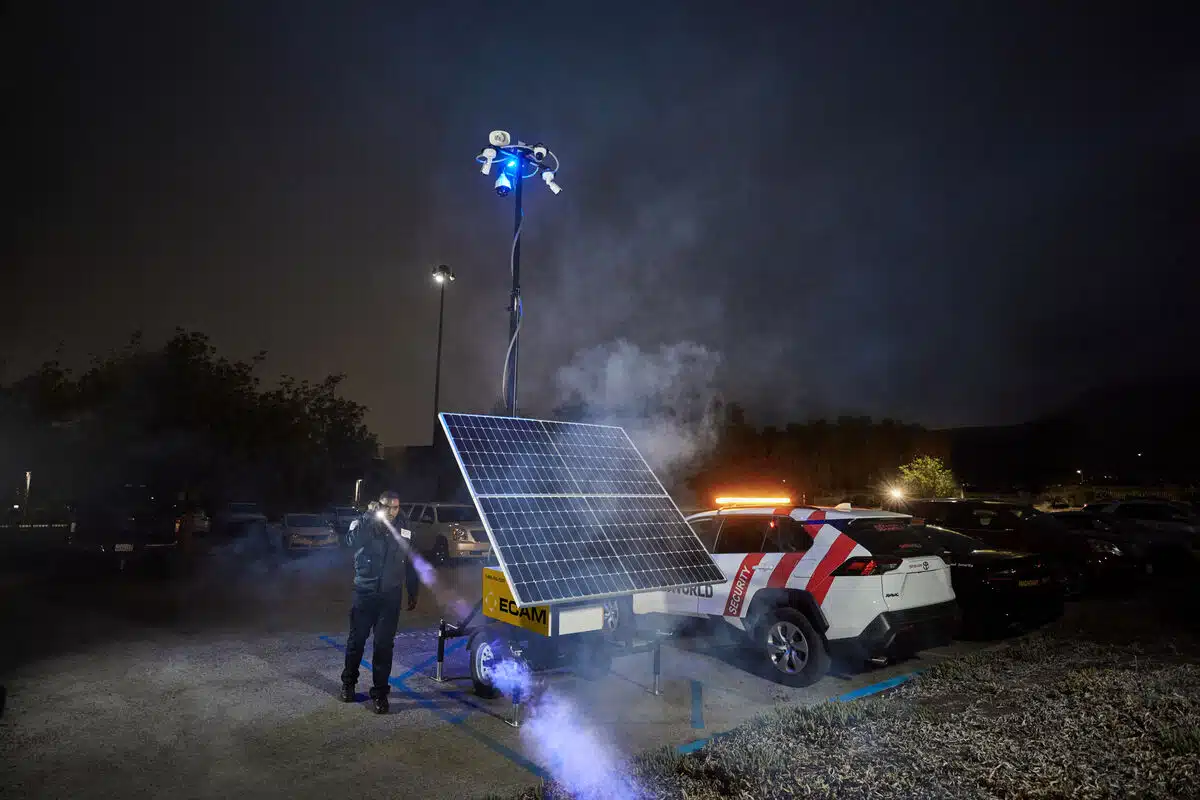



The Real Cost of Security Is the Coverage You Receive
When businesses compare remote video monitoring vs onsite security guards, the discussion often starts with price.
How much does a guard cost per hour? How much does a monitored camera system cost each month? Which option lowers the security budget?
Those questions matter, but they do not tell the whole story.
A security expense only creates value when it delivers the coverage the property needs. One guard may provide a physical presence at an entrance or patrol a large site periodically, but that person cannot observe every parking lot, perimeter, loading area, and equipment yard at the same time.
Remote video monitoring approaches coverage differently. Cameras provide visibility across multiple risk areas, while AI-assisted detection and trained operators help identify and address suspicious activity as it develops.
The most useful comparison is therefore not simply hourly labor versus monthly technology.
It is:
How much effective protection does each approach provide for the money being spent?
Two Ways to Build Security Coverage
Onsite guards and remote video monitoring are not identical services delivered through different methods. They are fundamentally different coverage models.
Onsite guard coverage is post-based
A business typically assigns a guard to a location, shift, patrol route, or defined responsibility. The organization pays for that person’s time, regardless of how much suspicious activity occurs during the shift.
The guard’s effectiveness depends on:
- Where the person is stationed
- How often patrols are completed
- Which areas can be seen from each position
- Whether the guard is occupied with another task
- How consistently procedures are followed
- What the guard happens to observe
Remote video monitoring is risk-based
A monitored system is designed around the areas and behaviors most likely to create loss.
Cameras can cover designated entrances, fence lines, parking areas, storage zones, and other vulnerable locations. AI-assisted detection identifies activity matching defined security rules, and monitoring professionals review those events to determine whether a response is necessary.
Instead of paying someone to remain at one post for an entire shift, the business invests in visibility and response across the areas that matter most.
Remote Video Monitoring vs Onsite Security Guards
| Coverage Factor | Onsite Security Guards | Remote Video Monitoring |
| How Coverage Is Purchased | Guard hours assigned to a post, shift, or patrol route | Monitored coverage designed around cameras, zones, and operating schedules |
| Field of View | Limited to the guard’s current location and line of sight | Multiple camera views can cover separate areas simultaneously |
| Coverage Consistency | May vary as guards patrol, take breaks, assist people, or complete other duties | Designated camera views remain available throughout monitored hours |
| Detection Method | Direct observation during a post assignment or patrol | AI-assisted event detection followed by operator verification |
| Response Capability | Physical presence, personal interaction, and on-site assistance | Live audio intervention, stakeholder notification, and police dispatch when appropriate |
| Scaling Coverage | Typically requires more guard hours or additional personnel | Typically requires additional cameras, monitored zones, or adjusted service hours |
| Primary Cost Driver | Recurring labor, scheduling, supervision, and post coverage | Equipment, installation, connectivity, maintenance, and monitoring service |
| Best Use | Tasks that require a person to be physically present | Broad visibility, after-hours detection, perimeter protection, and rapid verification |
| Key Limitation | One person cannot continuously observe every part of a large property | Cannot physically escort, inspect, assist, or intervene on site |
| Strongest Outcome | Human interaction and physical response at a defined location | Consistent detection and response coverage across distributed risk areas |
The better investment depends on whether the property primarily needs a person at a location or continuous visibility across multiple locations.
Why Guard Costs Extend Beyond the Hourly Rate
The hourly bill rate is only one part of the cost of an onsite guard program.
A complete evaluation may also need to consider:
- Overnight, weekend, and holiday coverage
- Overtime or schedule changes
- Relief coverage for absences and breaks
- Recruiting and turnover
- Training and supervision
- Uniforms and equipment
- Contract administration
- Additional personnel required for multiple posts
Coverage requirements can multiply quickly.
For example, a business that wants a post staffed around the clock is not purchasing one guard. It is purchasing enough labor to cover every shift, including breaks, days off, vacations, and unexpected absences.
The total cost rises further when the property needs simultaneous coverage at multiple entrances, buildings, or exterior areas.
That does not mean the expenditure is unjustified. When a person must check credentials, interact with visitors, conduct safety inspections, or provide physical assistance, guard coverage can be highly valuable.
The problem occurs when businesses pay guard rates for responsibilities that consist primarily of observing empty or lightly occupied areas.
How Remote Video Monitoring Costs Are Structured
Remote video monitoring does not usually follow an hourly labor model.
The total investment is generally influenced by factors such as:
- Number of cameras and monitored areas
- Existing equipment compatibility
- Property size and layout
- Installation requirements
- Lighting and camera placement
- Internet or cellular connectivity
- Hours of monitoring
- Detection rules and analytics
- Audio equipment
- Maintenance and service requirements
- Response and escalation procedures
That means two similarly sized properties may require very different systems.
A compact equipment yard with a clear perimeter may need fewer monitored views than a multifamily community with multiple buildings, parking areas, entrances, and common spaces.
The relevant question is not simply, “What does remote video monitoring cost?”
It is:
What level of coverage can the system provide, and which existing security expenses can it reduce or redirect?
Cost per Hour Does Not Equal Cost per Area Protected
An onsite guard may be affordable when assigned to one clearly defined responsibility. The economics become more difficult when that person is expected to protect a large or complex property.
Consider a guard responsible for:
- A main entrance
- Two parking lots
- A loading dock
- A rear fence line
- An equipment storage area
The guard may patrol each area, but coverage remains sequential. While the guard is inspecting one location, the others are temporarily unobserved.
Remote video monitoring can place cameras across all five areas. Operators do not need to stare continuously at every feed. AI-assisted analytics can flag activity that meets the property’s security rules for human review.
This changes the financial comparison.
The business is no longer comparing the cost of one guard with the cost of one camera. It is comparing the cost of limited mobile observation with the cost of simultaneous visibility across multiple risk areas.
How Effectiveness Should Be Measured
Security effectiveness should not be measured solely by whether a property has a guard or cameras.
A more useful evaluation examines the full response chain.
1. Detection
How quickly can the security program identify suspicious activity?
A guard must be looking in the correct direction or arrive during a patrol. A monitored system depends on appropriate camera placement, detection rules, image quality, and reliable connectivity.
2. Verification
Can the situation be assessed before resources are deployed?
Human verification helps distinguish between routine activity and a potential threat. Guards perform this assessment on site, while remote operators review the camera event.
3. Intervention
Can the security program influence the situation before the loss occurs?
A guard may address the person directly when doing so is safe and permitted. Remote operators may issue live audio warnings or alert designated contacts.
4. Escalation
Is there a clear process for contacting law enforcement or other responders?
Both approaches require established procedures. The method differs, but the value depends on what happens after the threat is confirmed.
5. Documentation
Does the program create useful records of the incident and response?
Remote monitoring can provide recorded video and a documented operator response. Guard programs may rely on written incident reports, available camera footage, or both.
An effective security strategy connects all five stages rather than relying on presence alone.
Where Onsite Guards Remain the Better Investment
Remote video monitoring is not a replacement for every guard responsibility.
Onsite guards may provide greater value when the property needs:
- Credential checks at controlled entrances
- Visitor reception and direction
- Package or vehicle inspections
- Employee escorts
- Safety patrols that require physical inspection
- Emergency assistance
- De-escalation and personal interaction
- Enforcement of site-specific access procedures
- Immediate physical presence at a fixed post
These responsibilities cannot be handled entirely through a camera.
A facility that needs frequent human interaction should not evaluate guards solely as a surveillance expense. The guard may be supporting security, safety, customer service, and operations at the same time.
Where Remote Video Monitoring Is Often More Effective
Remote video monitoring is particularly well suited to responsibilities centered on detection and visibility.
Common applications include:
- After-hours perimeter protection
- Parking lot surveillance
- Construction site monitoring
- Equipment and material storage
- Distribution and logistics yards
- Vacant or lightly staffed properties
- Remote infrastructure
- Multi-building commercial campuses
- Areas experiencing repeated trespassing or vandalism
These environments may cover too much ground for a single person to observe consistently.
Remote monitoring can provide a stronger fit because the system is distributed across the property rather than concentrated wherever a guard happens to be.
Three Security Models to Consider in 2026
The decision does not have to be reduced to choosing one solution and eliminating the other. Most properties fit one of three practical models.
Model 1: Guard-led security
In this model, guards handle most security responsibilities, while cameras primarily support visibility and evidence collection.
This may make sense for properties with heavy visitor traffic, strict access procedures, or frequent needs for physical assistance.
The risk is that guards may also be assigned broad surveillance responsibilities they cannot perform consistently across the entire property.
Model 2: Monitoring-led security
Remote monitoring handles after-hours observation, threat detection, verification, and escalation. Onsite personnel are limited or used only when specific physical duties require them.
This model can be effective for properties whose main concerns involve theft, trespassing, vandalism, and unauthorized exterior access.
It may also help reduce dependence on overnight patrols or guard posts dedicated primarily to observation.
Model 3: Hybrid security
A hybrid security model assigns remote monitoring and guards to different responsibilities.
Remote operators maintain visibility across perimeters, parking areas, and other camera-covered zones. Guards focus on access control, personal interaction, inspections, and situations that require someone on site.
This approach can improve the productivity of existing guards because they do not have to spend as much time conducting repetitive observation patrols.
The objective is not to duplicate coverage. It is to assign each responsibility to the resource best equipped to handle it.
A Cost Review Should Start With Guard Responsibilities
Businesses considering remote video monitoring often begin by counting guards. A better place to start is by reviewing what those guards actually do.
For each post or shift, ask:
- How much time is spent controlling access?
- How much time is spent interacting with employees or visitors?
- How much time is spent observing empty areas?
- Which patrol routes create gaps elsewhere?
- Which tasks require physical presence?
- Which tasks could be supported through monitored cameras?
- When do most incidents occur?
- Are guards stationed where the highest risks are located?
- Would removing a post create a safety or operational problem?
This process helps distinguish essential human responsibilities from surveillance duties that technology may perform more consistently.
It also avoids making broad decisions based only on the number of guards or the size of the security budget.
When Remote Monitoring Can Improve Guard Effectiveness
Remote monitoring can also serve as a force multiplier for onsite personnel.
Suppose an operator detects a person entering a restricted storage area. Instead of requiring a guard to discover the intrusion during the next patrol, the monitoring center can notify the guard and direct attention to the specific location.
That allows the guard to respond with:
- Better situational awareness
- A known location
- A description of the activity
- Recorded information about what occurred
- Support from remote operators who can continue observing
In this model, technology does not replace the guard. It reduces the amount of time the guard spends searching for problems.
The guard becomes a targeted responder rather than the property’s only source of detection.
Questions to Ask Before Changing Your Security Program
Before moving from onsite guards to remote video monitoring, or adopting a hybrid strategy, evaluate the property carefully.
Does the role require physical interaction?
If the post exists to greet visitors, check credentials, or inspect vehicles, cameras alone will not fulfill the requirement.
Is the current guard primarily watching property?
A post dedicated largely to observing parking lots, fence lines, or vacant areas may be a stronger candidate for monitored coverage.
How large is the coverage area?
The larger and more fragmented the property, the harder it becomes for one guard to maintain consistent awareness.
Are incidents being discovered during patrols or after the fact?
Repeated detection delays may indicate that the existing patrol model does not match the property’s risk.
Can existing cameras support professional monitoring?
Camera quality, placement, lighting, and connectivity must be evaluated before relying on the current system.
What response is required after detection?
The property still needs defined procedures for audio intervention, stakeholder notification, guard response, or law enforcement escalation.
The Stronger Strategy Buys the Right Type of Coverage
Remote video monitoring and onsite security guards create value in different ways.
Guards provide human interaction, physical presence, and on-site assistance. Remote monitoring provides distributed visibility, event detection, professional verification, and coordinated response across camera-covered areas.
The right decision is not necessarily the option with the lowest advertised price.
It is the option that delivers the most effective coverage for the risks the business actually faces.
For some organizations, that means reducing guard hours dedicated to observation. For others, it means retaining guards while adding remote monitoring to eliminate visibility gaps. Properties with significant access-control or customer-facing requirements may continue to rely heavily on onsite personnel.
The strongest security program is the one that assigns people and technology deliberately rather than using either as a one-size-fits-all solution.
Find the Right Balance of People and Technology
Every guard post, patrol route, and monitored camera should serve a defined security purpose. When responsibilities overlap or resources are assigned to the wrong tasks, costs can rise without producing stronger protection.
An ECAM security expert can evaluate your current guard program, camera coverage, operating hours, and property risks to identify opportunities to improve effectiveness and control long-term security costs.
Build a Stronger Security Strategy

Download Security Guides
Practical ebooks to help you strengthen your security and solve your challenges.

Discover Industry Security Solutions
See how ECAM protects your industry with solutions designed to deter crime, reduce losses, and keep operations moving.