
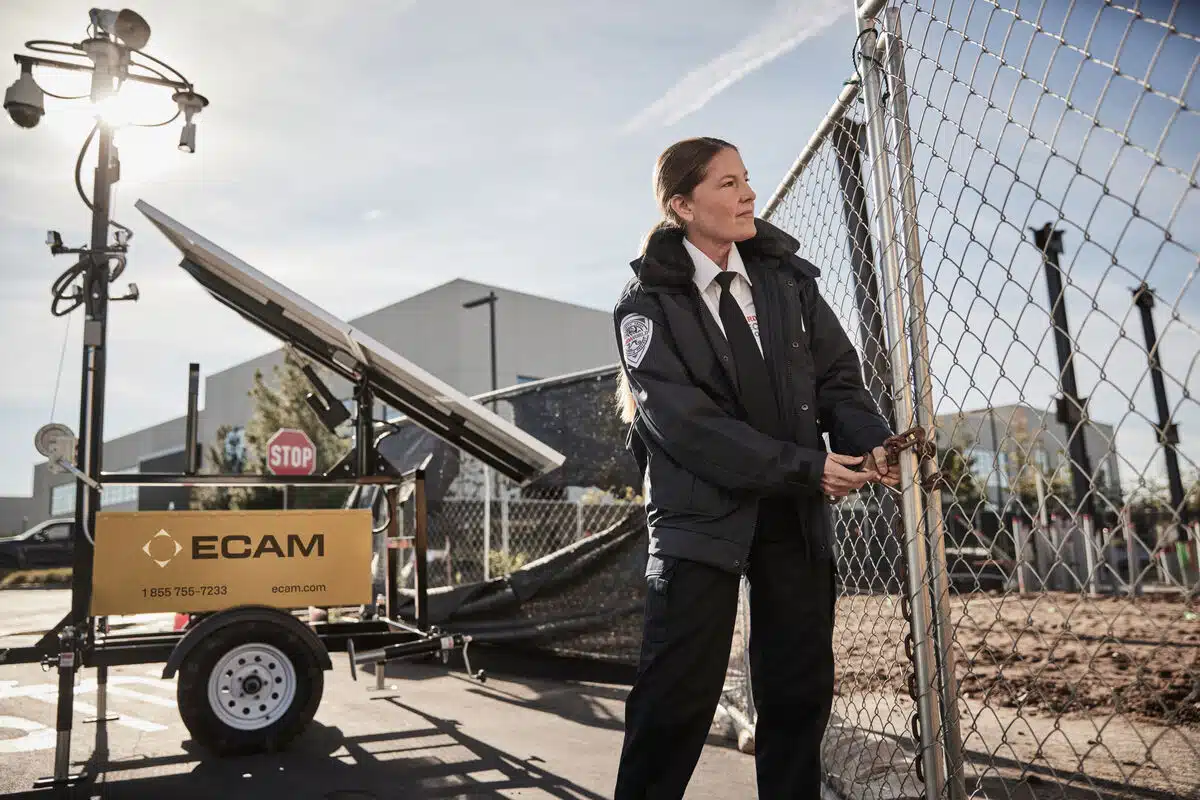



Security Costs Aren’t Just About Price
When evaluating security for your property, cost is often one of the first considerations.
Security guards have long been the standard, but remote video monitoring has emerged as a modern alternative. At first glance, the comparison may seem straightforward: hourly labor versus a technology-based solution.
But the real question isn’t just what each option costs. It’s what you’re getting in return.
If you’re comparing the cost of security guards vs remote video monitoring, you need to look beyond hourly rates and consider coverage, consistency, and the ability to actually prevent loss.
This comparison is designed for security leaders, operations teams, and business owners evaluating how to balance cost, risk, and protection.
Key Differences at a Glance
- Security guards require hourly labor, while video monitoring is typically a fixed or scalable monthly cost
- Guards provide limited coverage based on patrols, while video monitoring provides continuous, full-site visibility
- Video monitoring combines AI detection with real-time human intervention
- Guard performance can vary, while monitoring provides consistent, standardized coverage
- Guards may deter through presence, while monitoring enables active deterrence through audio and escalation
- Video monitoring creates recorded evidence and reporting, improving accountability and investigations
- Total cost should include not just labor, but risk reduction and loss prevention
Breaking Down the Cost Differences
| Category | Security Guards | Remote Video Monitoring |
| Cost Structure | Hourly labor (ongoing) | Monthly service-based pricing |
| Typical Cost Range | $20–$40+ per hour per guard | Typically lower total monthly cost depending on site size |
| Coverage | Limited to patrol areas and shifts | Continuous coverage across all cameras |
| Scalability | Requires additional staff | Easily scalable across sites |
| Overtime / Turnover Costs | Common and variable | Not applicable |
| Consistency | Varies by individual and shift | Standardized monitoring and response |
| Technology Included | Minimal | Cameras, AI detection, monitoring, reporting |
| Total Cost of Ownership | High due to labor and variability | More predictable and controlled |
Labor Costs vs Scalable Protection
Security guards are a labor-driven solution.
Costs typically include:
- Hourly wages
- Overtime
- Benefits (in some cases)
- Turnover and training
For overnight or 24/7 coverage, these costs multiply quickly. A single guard working overnight can cost tens of thousands of dollars annually, and full coverage often requires multiple shifts.
Remote video monitoring operates on a different model.
Instead of paying for physical presence, you’re paying for:
- Continuous surveillance across all areas
- AI-assisted detection
- Real-time human intervention
- Integrated reporting and documentation
This creates a more scalable cost structure, where protection is not limited by how many people you can afford to place on-site.
Coverage Gaps vs Continuous Monitoring
One of the biggest hidden costs of security guards is limited coverage.
A guard can only be in one place at a time. Even with patrols, there are gaps where areas go unobserved.
Remote video monitoring eliminates this limitation.
With cameras covering the entire site:
- Multiple areas are monitored simultaneously
- Suspicious activity is detected immediately
- Operators can respond within seconds
From a cost perspective, this means you’re not just paying less—you’re often getting more consistent and comprehensive protection.
Cost vs Risk: A Simple Decision Lens
When comparing the cost of security guards vs remote video monitoring, the decision often comes down to:
Are you paying for presence, or paying for prevention?
- If your priority is having someone physically on-site, guards may be appropriate
- If your priority is reducing theft, damage, and liability through consistent monitoring and response, video monitoring often delivers greater value
The lowest-cost option isn’t always the most effective. The real goal is to reduce total risk and loss, not just minimize upfront spend.
When a Hybrid Approach Makes Sense
For some organizations, the decision isn’t either-or.
A hybrid approach that combines remote video monitoring with selective on-site personnel can provide a balanced solution.
In this model:
- Video monitoring delivers continuous coverage and real-time response
- Guards are used for specific roles, such as daytime presence, customer interaction, or incident follow-up
This allows organizations to:
- Reduce reliance on expensive overnight staffing
- Maintain visibility across the entire site
- Allocate personnel where they add the most value
In most cases, video monitoring becomes the foundation of the security strategy, with guards serving as a supplemental layer.
Choosing the Right Approach for Your Situation
Both security guards and remote video monitoring can play a role, depending on your needs.
Security guards may be a strong fit if you:
- Require physical presence or interaction on-site
- Need coverage in smaller or highly controlled environments
- Are addressing specific operational or compliance requirements
Remote video monitoring may be a better fit if you:
- Want continuous, full-site visibility without coverage gaps
- Need real-time detection and intervention
- Are looking to reduce long-term security costs
- Want a scalable solution across multiple locations
- Prioritize preventing incidents, not just responding to them
Cost Is Only Part of the Equation
Security guards and remote video monitoring represent two fundamentally different cost models.
Security guards are based on labor and presence.
Remote video monitoring is based on coverage, detection, and real-time response.
While guards may seem straightforward from a pricing perspective, the total cost includes not just wages, but variability, limitations in coverage, and the potential for missed incidents.
Video monitoring offers a more predictable model focused on consistent protection and risk reduction.
For many organizations, the question isn’t just “which costs less,” but which approach is more effective at preventing loss over time.
What’s the Next Step?
If you’re evaluating security costs, the next step is understanding how different approaches apply to your specific site, risk level, and operational needs.
If you want to explore how video monitoring, mobile surveillance, and proactive security strategies work together, check out our Security Technology Buyer’s Guide.
If you’re ready to evaluate a more cost-effective, proactive approach, you can connect with an ECAM expert to review your site and identify opportunities to reduce risk in real time.
Build a Stronger Security Strategy

Download Security Guides
Practical ebooks to help you strengthen your security and solve your challenges.

Discover Industry Security Solutions
See how ECAM protects your industry with solutions designed to deter crime, reduce losses, and keep operations moving.