
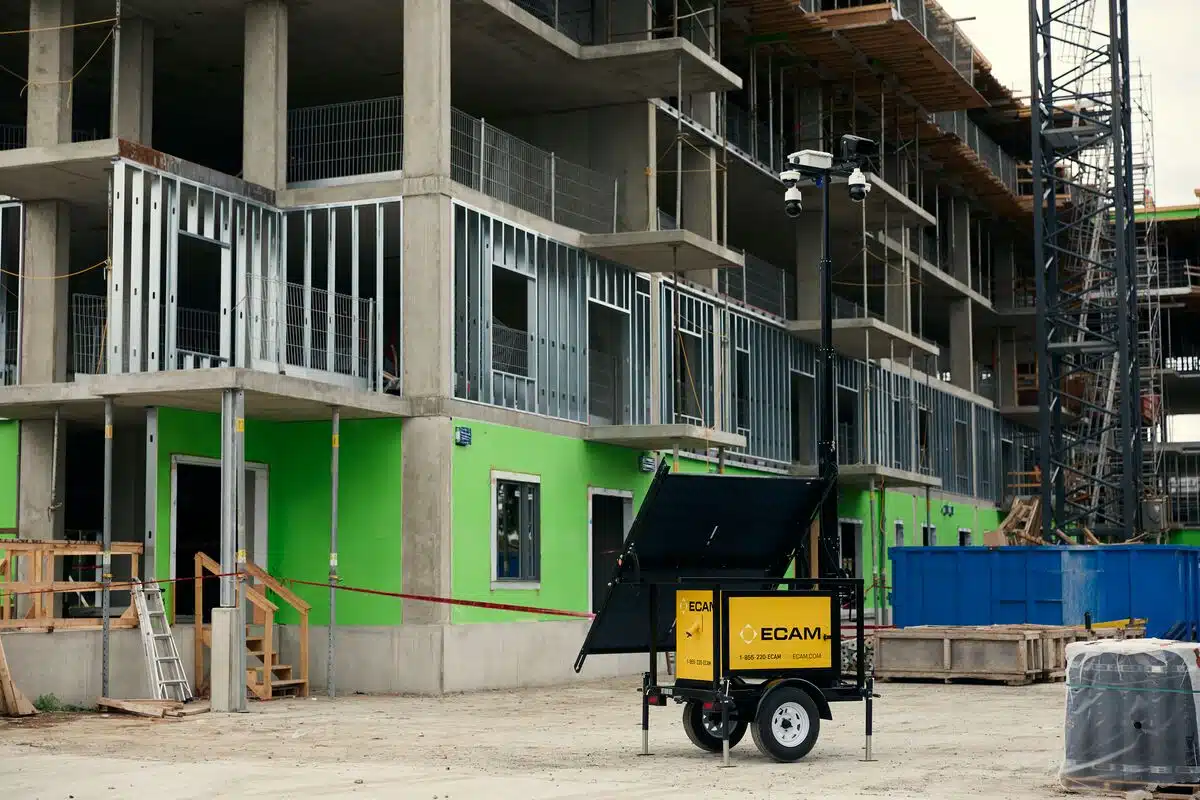



Theft prevention is often the first reason a construction team considers adding cameras to a jobsite. The threat is visible, the potential loss is easy to understand, and the consequences can be immediate. Missing equipment, stolen copper, or an emptied storage container can delay work and force the project team to replace assets that were already purchased once.
Yet theft represents only one part of the value that construction security camera systems can provide.
A construction project generates questions every day. Did the full delivery arrive? When was the equipment damaged? Who entered the restricted area? What happened before an injury was reported? Was a subcontractor present when an incident occurred? Which site condition contributed to a delay?
Without reliable documentation, project managers are often left reconstructing events through conflicting accounts, incomplete delivery records, text messages, and memory. Video cannot answer every question or replace a formal investigation, but it can provide a more objective record of what happened, when it happened, and who or what was present.
This broader operational value is frequently overlooked when cameras are evaluated only as theft-deterrence equipment. Properly designed construction security camera systems can support claims reviews, delivery verification, workplace investigations, subcontractor coordination, project documentation, and management visibility across one or several jobsites.
The difference lies in how the system is designed, maintained, monitored, and used.
Why Theft Prevention Is Only Part of Camera ROI
Theft is the most familiar construction security problem because the loss is tangible. A machine, tool, pallet, or quantity of material disappears, and the financial impact can often be calculated immediately.
Other jobsite costs are less visible but can be equally disruptive.
Consider an injury claim in which the sequence of events is unclear. The project team may need to interview several people, review safety records, and determine whether available evidence supports the account being presented. A disputed delivery may require hours of calls between the contractor, supplier, driver, and receiving team. A conflict between subcontractors may create different versions of the same event with no neutral point of reference.
In these situations, the value of construction site security cameras is not limited to identifying an intruder. The footage may help the team determine:
- When an event occurred
- Which people or vehicles were present
- Whether a delivery entered and left the site
- Where materials were unloaded
- How conditions changed before an incident
- Whether established procedures appear to have been followed
- Which areas require additional attention or control
This does not mean every camera will capture every relevant detail. It means that a thoughtfully designed surveillance program can give project leaders more reliable information than they would have otherwise.
The return on investment should therefore be considered across several categories: loss prevention, claims support, operational efficiency, dispute resolution, documentation, and management oversight.
Creating an Objective Record of Jobsite Activity
Construction sites are fluid environments. Workers rotate between projects, subcontractors enter and leave throughout the day, materials arrive in stages, access points change, and equipment moves as the build advances.
That activity creates operational complexity. It can also make incidents difficult to reconstruct.
Construction site surveillance systems provide a continuous visual record across selected areas of the project. Depending on camera placement and retention settings, that record can help project teams review entrances, delivery zones, equipment yards, storage areas, active work zones, and other high-value locations.
The objective is not to record every movement across the entire site. The objective is to create useful visibility around the activities most likely to affect risk, liability, or project continuity.
A complete visual record may help answer questions such as:
- When did a vehicle enter the property?
- Which gate did it use?
- Was a material delivery made to the correct location?
- Did equipment leave the site before or after the workday ended?
- Who was present near an incident area?
- When did an obstruction, access issue, or unsafe condition first appear?
- Did unauthorized activity occur before a loss was discovered?
This is where construction site monitoring can become an operational resource as well as a security function. Instead of relying only on recollections after the fact, teams can review a documented timeline and focus their investigation on observable events.
The footage does not make the decision for them. It gives them better information on which to base that decision.
Supporting Injury and Workers’ Compensation Reviews
Construction sites involve physical risk, changing work conditions, and multiple employers operating in the same environment. When an injury is reported, the project team may need to understand the surrounding circumstances quickly and carefully.
Recorded video can help investigators examine:
- Site conditions before the incident
- The sequence of activity leading to the event
- The presence of equipment, vehicles, or other workers
- Access to the relevant work area
- The timing of the reported injury
- Actions taken immediately afterward
Video evidence should not be treated as the sole basis for deciding the validity of an injury or workers’ compensation claim. Camera angles may be incomplete, critical activity may occur outside the field of view, and interpretation requires appropriate safety, legal, insurance, and human-resources review.
When relevant footage is available, however, it may help confirm details, identify inconsistencies, or clarify a sequence that would otherwise depend entirely on conflicting accounts.
This is one reason camera placement matters. Cameras installed only around the external perimeter may be effective for intrusion detection but provide little information about internal zones where workplace incidents occur. As structures rise and interior risk changes, construction jobsite security cameras may need to be repositioned or supplemented to maintain useful coverage.
The system must evolve with the project if it is expected to support more than one narrow use case.
Resolving Workplace and Subcontractor Disputes
Construction schedules create pressure. Multiple trades share space, deliveries overlap, responsibilities intersect, and disagreements can escalate quickly.
When a conflict occurs, project leadership may receive several versions of what happened. Each account may be sincere, but memory and perspective are imperfect. Even a relatively minor dispute can consume management time, damage working relationships, and distract from the schedule.
A construction site security surveillance program may provide an objective source of information when the relevant activity occurs within a covered area.
Footage may help clarify:
- Whether an individual entered another contractor’s work zone
- When equipment or materials were moved
- Which team was present before property was damaged
- Whether a confrontation occurred as described
- How long an obstruction or unsafe condition existed
- Whether site-access or delivery procedures were followed
The goal is not to turn the surveillance system into a tool for constantly scrutinizing workers. Its value is the ability to retrieve a reliable record when a significant operational, safety, or liability question arises.
Clear governance is essential. Project teams should establish who may request footage, who can authorize access, how video is stored, and how privacy and labor requirements will be addressed. These controls help ensure the system supports fair investigation rather than informal or inappropriate use.
Validating Deliveries and Missing-Material Claims
A delivery arrives during a busy workday. The driver leaves a shipment in a staging area, the receiving contact signs the paperwork, and several trades begin moving materials shortly afterward.
Days later, the team discovers that part of the shipment is missing.
Determining responsibility can be difficult. The supplier may maintain that the full order was delivered. The field team may say the pallets were incomplete when they arrived. A subcontractor may have moved the materials to another part of the project without updating the superintendent.
Strategically positioned construction site security camera systems can help reconstruct the delivery process.
Footage may show:
- When the delivery vehicle arrived
- Which access point it used
- Where the materials were unloaded
- How many pallets, containers, or major components were visible
- Whether the shipment was moved after delivery
- Which vehicles or crews accessed the staging area
- When the materials were last visible
The video may not show the contents of every package or replace receiving procedures, purchase records, and bills of lading. It can, however, add visual context that helps the contractor, supplier, and subcontractors narrow the dispute.
For projects receiving high-value appliances, electrical components, copper, mechanical equipment, or long-lead materials, delivery documentation can have implications beyond the replacement cost. Missing components may affect installation dates, inspections, trade sequencing, and the broader project schedule.
Camera coverage around delivery and laydown areas can therefore support both security and logistics.
Documenting Events That Affect Project Delays
When a security event disrupts a construction project, the immediate damage may be only part of the total impact.
A gate breach can force the site to pause while damage is inspected. Vandalism may require completed work to be repaired before another trade can proceed. Missing equipment may delay a scheduled activity. Trespassers entering an unfinished building may create sanitation, safety, or liability concerns that require remediation.
Video can help document when the disruption began, how it developed, and which areas were affected.
That record may support:
- Internal schedule reviews
- Insurance discussions
- Subcontractor coordination
- Damage assessments
- Incident investigations
- Documentation of access restrictions
- Evaluation of the security response
This is particularly useful when a delay has several contributing factors. The footage may show that an incident occurred at a specific time, that a restricted area remained inaccessible for a defined period, or that materials were moved following the event.
It should not be assumed that video alone will establish contractual responsibility or prove the full financial impact of a delay. Those determinations require broader project records and professional review. Video may still provide an important piece of the factual timeline.
What Makes Construction Video Useful as Evidence?
The presence of cameras does not automatically guarantee useful documentation.
A camera may technically record an area but fail to capture the details needed for review. The view may be obstructed, the image may be too distant, the timestamp may be inaccurate, or footage may no longer be available by the time someone requests it.
For construction video to provide meaningful operational value, several elements need to work together.
Strategic placement
Each camera should have a defined purpose. Coverage should prioritize access points, high-value storage, delivery zones, equipment yards, sensitive internal areas, and other locations tied to identifiable project risk.
Placement should reflect actual sightlines, lighting, elevation, structures, and obstructions. A plan developed only from an aerial image may miss critical field conditions.
Sufficient image quality
The system should capture enough detail for its intended purpose. A wide view may be appropriate for understanding site activity, while a narrower view may be needed to distinguish vehicles, behavior, or activity around a storage area.
Image quality should be evaluated under the conditions in which the camera is expected to perform, including darkness, changing weather, temporary lighting, and active construction.
Accurate timestamps
A reliable timestamp helps connect video with access records, delivery paperwork, alarm events, phone calls, incident reports, and other evidence.
Appropriate retention
Footage is only useful if it is still available when the need arises. Retention periods should account for how quickly theft, damage, injury claims, delivery discrepancies, and other concerns are typically reported.
Longer retention is not automatically better. Storage requirements, privacy obligations, and project-specific needs should all be considered.
System health and maintenance
A camera cannot support an investigation if it was offline during the relevant event. Construction security camera systems should include equipment-health oversight, connectivity monitoring, maintenance, and a clear process for resolving faults.
Event context
Video becomes more useful when it is connected to incident records, camera names, site maps, operator notes, alarm timelines, and response actions. A clip without context may show what happened but leave the project team uncertain about how the event was handled.
Ongoing adjustment
The field of view that worked during site preparation may become obstructed once framing, walls, scaffolding, or stored materials appear. Cameras need to be re-aimed, moved, or supplemented as the site evolves.
The quality of documentation depends on the quality of the entire operating program, not simply the camera specification.
Privacy, Governance, and Responsible Use
The broader the operational use of construction video becomes, the more important responsible governance is.
Project teams should establish clear policies around:
- Where cameras are permitted
- Which areas should never be recorded
- Whether and where surveillance signage is required
- How workers and subcontractors are notified
- Who can access live and recorded video
- Which circumstances justify a footage review
- How footage may be shared
- How long recordings are retained
- How requests related to claims or litigation are handled
- Who approves exports or external disclosure
Cameras should not be placed in areas where workers have a reasonable expectation of privacy. Applicable privacy, labor, employment, and surveillance laws can vary by jurisdiction, and qualified legal guidance should be used when developing policy.
The purpose of the system should also be communicated clearly. When workers understand that cameras support site protection, incident review, delivery documentation, and safety investigations, the program is less likely to be perceived as arbitrary or hidden monitoring.
Responsible use protects both the workforce and the value of the footage. Poor access controls, inconsistent retention, or unclear authority can undermine trust and complicate the very investigation the video was intended to support.
Using Construction Site Monitoring Across Multiple Projects
For a contractor or owner-developer managing several active builds, the value of video grows when information can be accessed and reviewed consistently across the portfolio.
Centralized remote video monitoring may allow authorized leaders to:
- View activity across multiple jobsites
- Review incidents and response records
- Compare recurring risk patterns
- Verify that systems are operating
- Coordinate service and maintenance
- Examine delivery or project documentation
- Apply consistent monitoring and escalation standards
- Identify sites that require coverage changes
This can be particularly useful for safety directors and enterprise risk leaders whose responsibilities extend beyond a single project. They may need visibility into recurring claims, intrusion patterns, equipment outages, or response performance across regions.
A centralized platform can simplify access to live views, incident information, historical footage, service status, and reporting. Natalie’s SME feedback indicates that ECAM Central is especially effective when demonstrated before the sale because it helps buyers understand how the cameras, monitoring, incidents, and service relationship fit together.
The platform itself does not create the value. The value comes from making the information generated by the security program accessible, organized, and actionable for the people responsible for the project.
How to Evaluate the Full Value of a Camera System
When comparing construction security camera systems, buyers should look beyond the monthly rate and camera count.
A more complete evaluation asks:
- Was the system designed after a physical site assessment?
- Does each camera address a defined risk or operational need?
- Can coverage adapt as the project changes?
- Is footage actively monitored or only recorded?
- Who verifies alarms and initiates a response?
- Can the system support injury, dispute, and delivery reviews?
- How long is footage retained?
- How is system health monitored?
- Who performs maintenance, repairs, re-aims, and relocations?
- What incident reports and event timelines are available?
- Can footage be accessed across multiple projects?
- Who is accountable when a camera or connection fails?
- Are privacy, access, and retention policies clearly defined?
- Does the provider manage the complete system or depend on several separate vendors?
These questions reveal the practical difference between renting cameras and building a dependable visibility program.
The lowest-cost proposal may still be the right choice for a particular project, but only when the project team understands what is included, what is excluded, and how those differences affect performance and management effort.
A camera system should be evaluated according to the outcomes it supports, the work it removes from the project team, and the clarity it provides when something goes wrong.
Turn Jobsite Visibility Into Operational Value
Theft deterrence remains an important purpose of construction security camera systems, but it should not define their entire value.
A well-designed system can help project teams understand incidents, verify deliveries, review injury claims, resolve disputes, document disruptions, and maintain better visibility across an evolving jobsite. For multi-project operators, that information can also support more consistent risk management and oversight across the organization.
These outcomes depend on more than installing cameras. They require thoughtful placement, reliable recording, appropriate retention, system-health oversight, ongoing adjustments, controlled access, and clear accountability.
When those elements are managed as one coordinated program, construction video becomes more than evidence of a theft. It becomes an operational record that helps teams protect schedules, manage risk, and make better-informed decisions throughout the build.
Get More Value From Jobsite Visibility
ECAM designs, installs, monitors, maintains, and adjusts construction camera systems around the real conditions of each project. Create a visibility strategy that supports theft deterrence, claims review, delivery validation, incident documentation, and project oversight through one accountable security partner.
Build a Stronger Security Strategy

Download Security Guides
Practical ebooks to help you strengthen your security and solve your challenges.

Discover Industry Security Solutions
See how ECAM protects your industry with solutions designed to deter crime, reduce losses, and keep operations moving.