
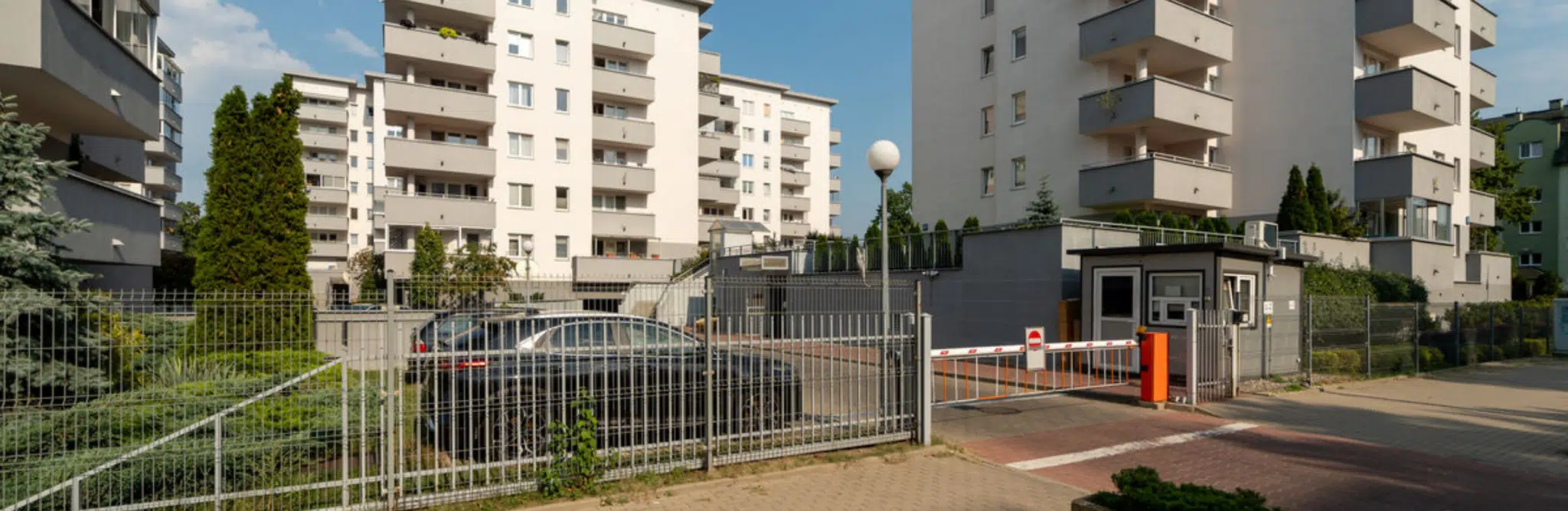



A camera can document someone entering through a broken gate, but it cannot make the gate function correctly.
Recurring security problems at multifamily properties often begin with basic infrastructure weaknesses. A vehicle gate remains open, a pedestrian entrance does not latch, residents prop open a side door, or poor lighting makes it difficult to see who is entering. Once these conditions become routine, unauthorized access can lead to vehicle break-ins, package theft, amenity misuse, loitering, vandalism, and other resident concerns.
Effective multi-family residential security solutions must therefore extend beyond the gate itself. Gates and access control help regulate entry. Cameras provide visibility. Live monitoring helps identify suspicious behavior as it occurs. Property teams, technicians, guards, and other responders address the physical or operational conditions that technology cannot correct on its own.
The objective is not simply to record unauthorized entry. It is to understand how people are gaining access, address the weaknesses that make it possible, and create a layered strategy that reduces the likelihood of the same problem happening again.
Why Gate Problems Create Recurring Multifamily Security Issues
A malfunctioning gate can turn a controlled property into an open one.
When vehicle gates, pedestrian entrances, and exterior doors work correctly, they create multiple layers between public areas and resident-only spaces. Those barriers may not prevent every unauthorized entry, but they make access more difficult and help establish where residents, guests, delivery drivers, and vendors are expected to enter.
When one of those barriers fails, the effect can extend throughout the property. Someone who enters through an open vehicle gate may gain access to a parking garage, mail area, amenity, or residential building. A person who follows a resident through an unsecured pedestrian entrance may remain on the property without attracting immediate attention.
The same vulnerability can be exploited repeatedly until it is corrected. Property teams may respond to multiple complaints and review multiple incidents without recognizing that they all began at the same access point.
This is why gate security should be evaluated as an operational issue, not only a hardware issue. Property teams need to understand:
- Whether the gate or door works consistently
- How authorized users are expected to enter
- How unauthorized individuals are bypassing the system
- Whether cameras provide usable visibility
- How quickly malfunctions are reported and repaired
- Who responds when suspicious activity is detected
- Whether recurring access patterns are being documented
A layered approach turns each incident into information the property can use to strengthen the underlying security program.
Common Weaknesses in Multifamily Gates and Entrances
Access problems can develop for many reasons. Some involve damaged equipment, while others result from property design, resident behavior, or unclear operating procedures.
Gates left open
A gate may remain open because of a mechanical problem, a temporary maintenance decision, heavy traffic, or an attempt to make access more convenient.
Regardless of the reason, a gate that remains open for extended periods cannot perform its primary function. It also makes it difficult for monitoring personnel to determine whether an entering vehicle is authorized.
Broken operators or locks
Vehicle gate operators, pedestrian locks, door closers, and access readers can fail over time. A gate may stop closing completely, a pedestrian entrance may not latch, or a door may appear secure without actually locking.
These problems are especially concerning when they remain unnoticed after the property office closes.
Tailgating
Tailgating occurs when an unauthorized vehicle or person follows an authorized user through an entrance before the gate or door closes.
The gate may be working as designed, but the timing of entry creates an opportunity for someone without valid credentials. Tailgating can be difficult to prevent through access control alone because the system recognizes the authorized user, not necessarily everyone entering behind them.
Pedestrian entry gaps
A property may have strong vehicle access control but weaker pedestrian access. Gaps in fencing, unlocked walk-through gates, open pathways, or poorly secured side entrances can allow people to bypass the primary gate entirely.
Evaluating only the main vehicle entrance can therefore create a false sense of control.
Propped doors
Residents, delivery drivers, contractors, and staff may prop open exterior doors for convenience. Even if the door has a functioning lock and access reader, it cannot control entry while it remains open.
Repeated door-propping may indicate a behavioral issue, a delivery-process problem, or an access system that is inconvenient for legitimate users.
Poorly lit entrances
Insufficient lighting can make it harder for residents to see who is near an entrance and reduce the usefulness of camera footage. Glare, shadows, and uneven illumination may prevent operators or investigators from identifying important details.
Lighting is both a visibility tool and a fundamental part of the property environment.
Limited visibility around access points
Landscaping, walls, parked vehicles, signage, and poorly positioned cameras can obstruct entrances. Property staff may know that someone entered but lack a clear view of the person, vehicle, license plate, or method of entry.
Visibility should be assessed from both the resident’s perspective and the camera’s perspective.
Slow repair processes
A minor malfunction can become a long-term vulnerability when ownership, management, technicians, and vendors are not aligned on who is responsible for the repair.
The longer an entrance remains unsecured, the more likely residents and unauthorized visitors are to treat the condition as normal. Temporary workarounds can quickly become permanent operating habits.
Why Cameras Cannot Compensate for a Broken Gate
Cameras provide information. They do not create a physical barrier.
If someone enters through the same broken gate every night, installing another camera may provide an additional view of the activity. It does not remove the access opportunity.
As the multifamily SME explained, catching someone each time they enter through a broken gate is less effective than repairing the gate so the property does not face the same test every night. That distinction should guide how properties evaluate multi-family residential security solutions.
Camera footage can reveal:
- How people are bypassing an entrance
- When the problem occurs most often
- Whether tailgating is involved
- How long a gate remains open
- Whether the gate closes consistently
- Which vehicles or individuals are connected to recurring activity
- Whether a malfunction or deliberate damage caused the problem
That information should support corrective action. Depending on the cause, the appropriate next step may be repairing the gate, adjusting closing times, improving lighting, changing access procedures, addressing resident behavior, or adding monitoring.
The goal is not to choose infrastructure instead of cameras. It is to make sure each component is performing the job it is designed to do.
How Security Cameras Support Multifamily Gate Security
Although cameras cannot replace functional gates, they play an essential role in understanding and managing access.
Well-positioned cameras can provide visibility into:
- Vehicles approaching and entering
- Drivers using access credentials
- Vehicles following residents through the gate
- Pedestrians entering alongside vehicles
- People climbing or bypassing gates
- Damage to gate arms or operators
- Doors being propped open
- Activity near pedestrian entrances
- The direction people travel after entering
The strongest multi-family residential security camera solutions capture more than the gate itself. They provide enough context to show what happened before, during, and after entry.
For example, one camera may show a vehicle approaching the gate, while another captures the driver or license plate. An interior camera may show whether a second vehicle followed through. Additional views may reveal where the vehicle traveled after entering.
Camera placement should be guided by the questions the property may need to answer later. A wide view can show overall activity, while a more focused view may be necessary for identifying vehicles or understanding how an access point was defeated.
Image quality also matters. Cameras must account for nighttime conditions, headlights, shadows, and the speed of moving vehicles. A camera that technically covers an entrance may still provide little value if the relevant details cannot be seen.
How Live Video Monitoring Adds Real-Time Oversight
Recorded footage helps explain what happened. Multi-family residential remote video monitoring can help property teams address suspicious activity while it is still occurring.
Multifamily entrances remain active after traditional business hours. Residents return home, guests arrive, delivery drivers make stops, and vehicles move through gates. Because so much of that activity is legitimate, movement alone does not necessarily indicate a problem.
Live operators can evaluate the surrounding context. They may observe that a vehicle is waiting for a resident to open the gate, a person is attempting several doors, or someone has remained near an entrance to follow another resident inside.
Depending on the property’s response procedures, operators may:
- Issue a live audio warning
- Contact an on-site security guard
- Notify a designated property representative
- Escalate verified suspicious activity
- Continue observing the person or vehicle
- Follow activity across available camera views
- Document the event and response
This oversight can make access systems more effective. Gates control entry when they work correctly. Monitoring helps identify when someone bypasses them, damages them, or uses legitimate traffic as an opportunity to enter.
Effective multi-family residential security camera monitoring should also account for the property’s normal activity. Operators need to know which entrances are active, when amenities close, how deliveries are handled, and who should be contacted when a problem occurs.
Using Video to Identify Damage and Hold the Right Party Accountable
Gate damage is not always caused by an unknown intruder. Residents, guests, delivery drivers, and contractors may strike a gate, force it open, or enter before it has fully moved.
Without video, property staff may discover the damage later and have little information about how it occurred. The property then absorbs the repair expense and manages the access vulnerability until the gate is restored.
Video can help reconstruct the event by showing:
- The vehicle approaching the entrance
- Whether access was authorized
- How the gate was damaged
- The vehicle’s identifying characteristics
- When the damage occurred
- Whether the driver stopped or left
- How the damaged gate affected later access
The multifamily SME described the practical value of placing a camera at a gate where vehicles had caused repeated damage. Instead of simply receiving another repair bill, the property could use video to identify the vehicle involved and determine whether the cost could be passed to the responsible resident or party.
This is an important example of security supporting property operations. The value is not limited to detecting crime. Video can help explain damage, assign responsibility, reduce investigation time, and potentially prevent the property from absorbing avoidable expenses.
Combining Gates, Lighting, Cameras, and Access Control
No single component can solve every access problem.
A layered entrance strategy assigns a clear function to each part of the system:
Gates and doors create physical barriers
They define the boundary between public and controlled areas. Their value depends on reliable operation, timely maintenance, and appropriate placement.
Access control manages authorized entry
Credentials, key fobs, codes, intercoms, and other access tools determine who can enter and create a structured process for residents, staff, vendors, and guests.
Lighting improves visibility
Consistent lighting helps residents navigate entrances, supports camera performance, and makes behavior around access points easier to observe.
Cameras provide visual information
Cameras document how people and vehicles approach, enter, and move beyond the access point. They support both live oversight and later investigation.
Monitoring adds human evaluation
Operators assess behavior, distinguish routine use from suspicious activity, and initiate the agreed response when necessary.
Property teams correct operational problems
Management and maintenance teams repair equipment, address resident behavior, update procedures, and coordinate with vendors.
Each layer strengthens the others. Cameras are more useful when lighting is adequate. Monitoring is more effective when operators have clear camera views. Access control performs better when doors and gates close correctly. Repairs happen faster when the property receives timely information about damage or failure.
When Remote Monitoring Should Be Paired With On-Site Response
Remote operators can identify and communicate about suspicious activity, but some situations still require someone at the property.
An on-site guard may be better positioned to:
- Inspect an entrance in person
- Confirm whether a gate or door is damaged
- Approach an individual when appropriate
- Patrol interior spaces
- Assist residents
- Enforce property policies
- Respond to an operator’s notification
- Secure an area until repairs can be made
This does not mean a guard must remain stationed at the gate. Multi-family residential video monitoring can maintain broader visibility while the guard performs patrols or handles resident-facing responsibilities.
A coordinated hybrid strategy may allow remote operators to watch parking areas, amenities, exterior spaces, and entrances while directing guards to specific locations when attention is needed.
Clear procedures are essential. Monitoring personnel should know whom to contact, what situations warrant a response, and how the on-site person will confirm arrival. Guards should understand which areas are monitored and what information operators can provide.
Technology and personnel are most effective when they operate as one security program rather than separate services.
How to Evaluate Gate Security Across a Multifamily Portfolio
A single property can address a gate problem as it appears. A portfolio-level evaluation can reveal whether similar weaknesses exist across multiple communities.
Regional managers, asset managers, and ownership teams should consider creating a consistent assessment process that examines:
- The number and type of vehicle and pedestrian entrances
- Gate and door condition
- Access control technology
- Repair frequency and response time
- Lighting at each entrance
- Camera placement and image quality
- Tailgating patterns
- Propped-door complaints
- Unauthorized access incidents
- Monitoring hours and response procedures
- On-site staffing
- Incident documentation
- Vendor responsibility
Standardization does not mean giving every property the same equipment. A garden-style community with open parking and multiple pedestrian paths has different needs from an urban high-rise with a garage, lobby, elevators, and controlled interior doors.
The purpose of a portfolio assessment is to establish consistent expectations while allowing the solution to reflect each property’s design and risk profile.
Consistent reporting can also reveal patterns that are difficult to see at one property. Ownership may discover that certain gate operators fail repeatedly, repair delays are common across one region, or several communities experience similar tailgating problems.
Those insights can inform capital planning, vendor decisions, operating procedures, and future security investments.
Building a Plan That Addresses Root Causes
A stronger gate security plan begins by identifying why unauthorized access continues to occur.
Property teams should ask:
- Is the physical barrier working?
Confirm that gates, doors, locks, fences, and operators function reliably. - Can legitimate users enter without creating unsafe workarounds?
Frequent door-propping or gate interference may indicate that the access process is inconvenient or unreliable. - Can the property clearly see what happens at each entrance?
Evaluate lighting, camera angles, obstructions, and image quality. - Is suspicious activity evaluated while it is occurring?
Determine whether recorded video is sufficient or whether live monitoring is needed. - Is there a defined response?
Establish when operators should use live audio, contact a guard, notify management, or escalate an event. - Are repeated problems analyzed?
Look beyond individual incidents to identify common entry methods, times, locations, and infrastructure failures. - Is one party accountable for system performance?
Clarify responsibility for design, installation, monitoring, maintenance, footage retrieval, and support.
The appropriate solution may involve repairing a gate, improving lighting, repositioning cameras, adding remote monitoring, changing access procedures, coordinating with guards, or combining several actions.
What matters is that every recommendation addresses a defined weakness. Adding technology without correcting the underlying condition may produce more footage without producing a better outcome.
Strengthen the Entire Access Strategy
Gate security is most effective when physical barriers, lighting, cameras, monitoring, and on-site response work together. ECAM can assess your property’s entrances, recurring access problems, existing camera coverage, monitoring needs, and response procedures to identify where repairs, improvements, or added oversight may provide the greatest value. Speak with an ECAM expert to build a strategy that addresses access problems at their source.
Build a Stronger Security Strategy

Download Security Guides
Practical ebooks to help you strengthen your security and solve your challenges.

Discover Industry Security Solutions
See how ECAM protects your industry with solutions designed to deter crime, reduce losses, and keep operations moving.