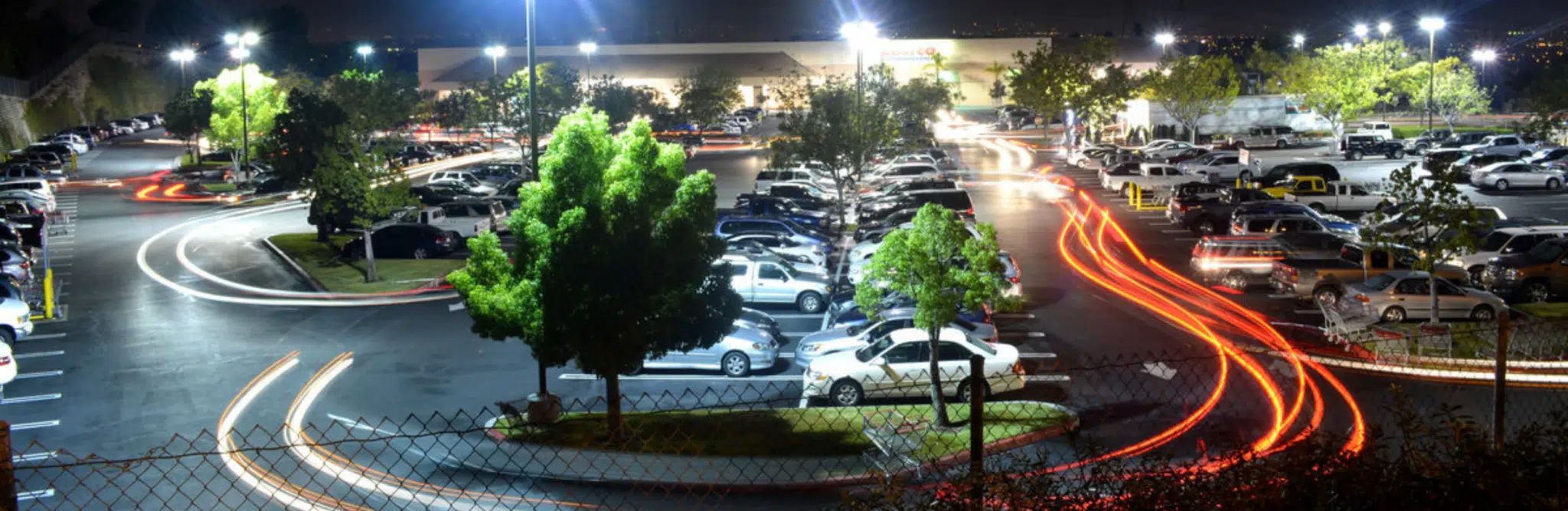



Parking lots are often among the most heavily monitored areas of a property.
Cameras overlook entrances and exits, cover driving lanes, observe pedestrian traffic, and monitor large sections of open space. On paper, visibility appears comprehensive. In many cases, property owners can review footage from virtually any angle after an incident occurs.
Yet parking lots continue to present security challenges.
The reason is not necessarily a lack of cameras. More often, it is a lack of awareness.
There is an important difference between capturing activity and understanding it. Parking lot security cameras may record thousands of hours of footage each month, but if no one is actively interpreting what those systems are seeing, critical events can still go unnoticed until after they have already developed.
This visibility gap has become one of the defining challenges in modern parking lot security.
Why Parking Lots Create Unique Security Challenges
Unlike interior spaces, parking lots operate as open environments.
People arrive and leave at different times. Vehicles move continuously throughout the day. Lighting conditions change dramatically between daylight and overnight hours. Activity that appears routine in one moment may become suspicious in another.
This creates a security environment where context matters.
A vehicle idling near an entrance for a few moments may be completely normal. The same vehicle remaining in place for an extended period after hours may require attention. Similarly, pedestrian movement through a parking area may be expected during business hours but unusual late at night.
Traditional parking lot surveillance systems capture these events, but they do not always provide the context needed to determine what matters and what does not.
The Difference Between Surveillance and Awareness
Many organizations assume that once parking lot security cameras are installed, the security challenge has been solved.
In reality, cameras primarily create visibility.
Awareness requires something more.
Footage has to be interpreted, activity must be evaluated, and unusual behavior needs to be identified within the broader flow of normal operations. Without that layer, cameras often function as investigative tools rather than preventative ones.
This distinction helps explain why properties with extensive camera coverage can still experience recurring security issues.
The system sees the activity.
The challenge is recognizing its significance before an incident occurs.
How Modern Parking Lot Surveillance Is Evolving
The role of parking lot video surveillance has changed significantly over the past decade.
Historically, surveillance systems were designed around recording. Their primary purpose was to preserve evidence and support investigations. Today, organizations increasingly expect those same systems to contribute to real-time decision-making.
This shift has been driven by advances in both AI analytics and monitoring.
Rather than simply storing footage, modern systems can help identify activity that deserves attention. Monitoring teams can then evaluate those events, determine whether intervention is necessary, and support an appropriate response.
The result is a more proactive security model.
Why AI Alone Is Not the Answer
Artificial intelligence has introduced important capabilities to parking lot security camera systems.
Modern analytics can help distinguish between people, vehicles, and environmental movement. They can identify activity occurring in restricted zones, recognize unusual movement patterns, and reduce the noise associated with traditional motion detection.
These improvements help improve efficiency, but they do not eliminate the need for human judgment.
Parking lots are highly contextual environments. What appears unusual in one situation may be entirely normal in another. AI can identify potential concerns, but determining whether an event actually requires action often depends on human interpretation.
This is why many organizations are combining analytics with active monitoring rather than relying on either approach independently.
Closing the Visibility Gap with Live Monitoring
The most effective parking lot security camera systems are increasingly built around a combination of technology and oversight.
Analytics help surface meaningful events. Monitoring teams evaluate those events in real time. Response protocols ensure that activity can be addressed when necessary.
This layered approach transforms cameras from passive recording devices into active security tools.
Instead of simply documenting incidents, the system becomes part of an ongoing process of awareness and response.
For parking lots, where activity is constant and conditions change throughout the day, that distinction can be significant.
Beyond Cameras: Building a Parking Lot Security Strategy
A parking lot camera is an important component of any security strategy, but it is only one piece of a larger system.
The effectiveness of parking lot security depends on how visibility, monitoring, analytics, and response work together. When those elements are aligned, organizations gain more than footage. They gain a better understanding of what is happening across the property and the ability to act on that information when it matters.
That is ultimately where the value of modern parking lot security cameras is found.
Not in what they record, but in what they help organizations see.