



Quick Answer
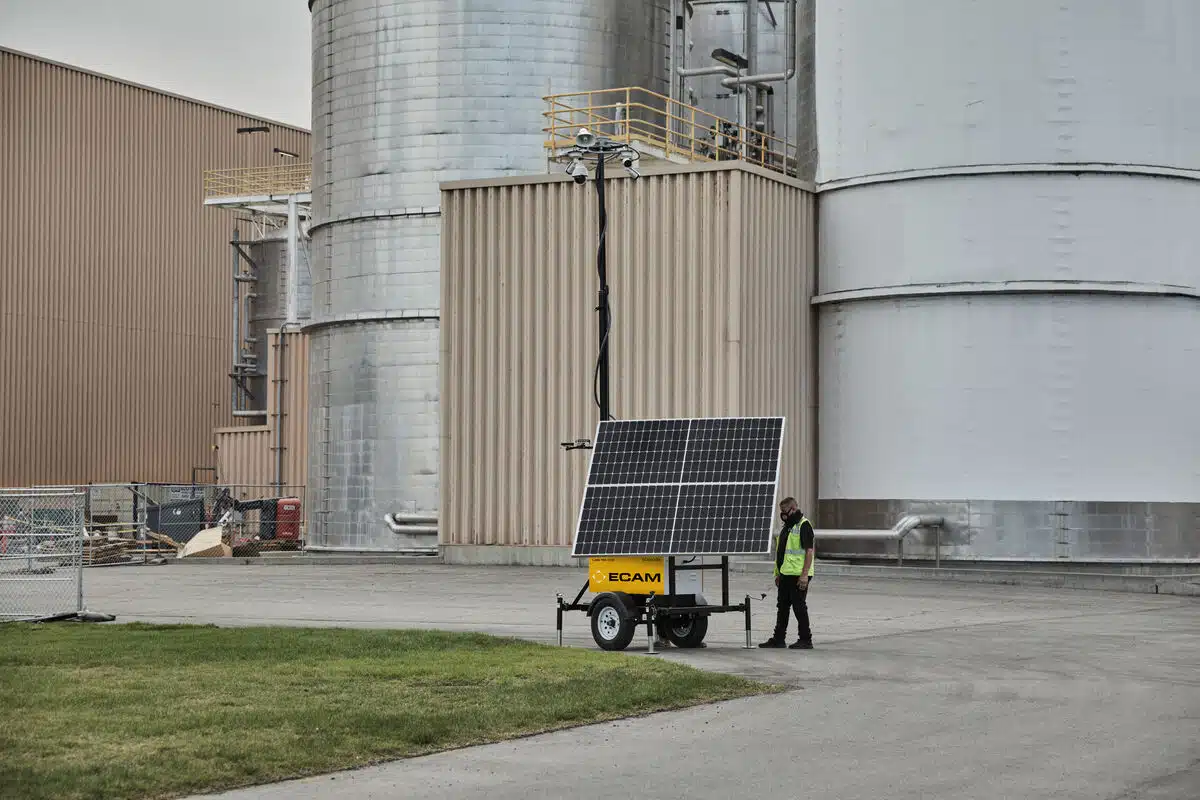
Mobile security towers work by combining elevated surveillance cameras, power and connectivity, video analytics, remote monitoring, and deterrence capabilities in a rapidly deployable security platform. Once positioned at a site, cameras provide visibility across targeted areas, analytics identify activity that may require attention, and trained remote monitoring professionals can verify events and respond according to predefined security protocols.
Because they do not depend on permanent security infrastructure, mobile security towers are particularly useful for construction sites, parking lots, vacant properties, equipment yards, and other outdoor environments where security needs may change over time.
Key Takeaways
- Mobile security towers combine cameras, analytics, connectivity, power, and monitoring into a deployable surveillance solution.
- Elevated cameras provide visibility across large outdoor areas and help reduce blind spots.
- Depending on the unit, solar panels, batteries, or other power options can support operation where permanent power is unavailable.
- Video analytics help identify activity that requires attention instead of relying on someone to continuously watch every camera feed.
- Trained monitoring professionals can verify alerts and respond through audio warnings, site notifications, or law enforcement escalation when appropriate.
- Mobile security towers can be relocated as site layouts, risk areas, or security needs change.
Table of Contents
- What is a mobile security tower?
- How do mobile security towers work?
- How are mobile security towers powered?
- How do mobile security towers connect to monitoring centers?
- What role does AI play in mobile security towers?
- What happens when a security threat is detected?
- Where are mobile security towers used?
- How are mobile security towers different from fixed security cameras?
- Frequently asked questions
- Bottom line
What Is a Mobile Security Tower?
A mobile security tower is a rapidly deployable surveillance platform designed to provide camera coverage, threat detection, and remote monitoring without requiring a traditional permanent camera installation.
These systems are also commonly referred to as:
- Mobile surveillance units (MSUs)
- Mobile surveillance towers
- Security camera trailers
- Surveillance trailers
Configurations vary, but a mobile security tower typically brings several security technologies together on one platform:
- Elevated surveillance cameras
- Video analytics
- Remote connectivity
- Independent or supplemental power
- Live video monitoring
- Audio deterrence capabilities
Unlike a permanently mounted commercial camera system, the unit can be positioned where surveillance is needed and moved as those needs change.
That mobility is particularly valuable in environments where the security perimeter itself isn’t permanent.
How Do Mobile Security Towers Work?
Mobile security towers follow a detect, verify, respond model similar to other forms of proactive video monitoring, but package the necessary surveillance infrastructure into a mobile platform.
Here’s how the process works.
Step 1: The Tower Is Deployed Strategically
The first step is determining where surveillance coverage is needed.
A mobile security tower may be positioned near:
- Property entrances
- Construction equipment
- Material storage
- Parking areas
- Perimeter boundaries
- Loading areas
- Vacant buildings
- Other high-risk locations
Placement matters because the objective isn’t simply to put a tower on the property. It is to give cameras useful visibility across the areas where threats are most likely to occur.
Step 2: Elevated Cameras Provide Site Visibility
Once deployed, the tower elevates its cameras above ground level.
That elevated position helps cameras see across:
- Fencing
- Parked vehicles
- Equipment
- Materials
- Other objects that can obstruct ground-level cameras
Depending on the configuration, a tower may use multiple cameras or different camera types to provide coverage across targeted areas.
This can make mobile towers particularly effective for large outdoor environments.
Step 3: Video Analytics Monitor for Defined Activity
Modern mobile security towers can use video analytics to continuously analyze camera feeds.
Instead of requiring a security professional to stare at every camera around the clock, analytics can identify events that match predefined security rules.
Depending on the system, these may include:
- A person entering a restricted area
- After-hours movement
- Loitering
- A perimeter breach
- Suspicious vehicle activity
- Unauthorized access
When the system identifies relevant activity, it generates an alert for further review.
Step 4: A Trained Operator Verifies the Alert
An alert doesn’t automatically mean a crime is occurring.
Authorized employees, contractors, wildlife, weather, and normal site operations can all create activity.
That’s where human verification becomes important.
A trained remote monitoring professional reviews the event and determines whether it represents a legitimate security concern.
This combination allows technology to handle continuous detection while people provide context and judgment.
Step 5: The Operator Responds
If the activity is determined to be suspicious, the operator follows the property’s established response procedures.
Depending on the situation, that may include:
- Issuing an audio warning
- Activating available deterrence features
- Notifying a designated site contact
- Escalating a verified incident to law enforcement
- Continuing to observe the situation as it develops
The objective is to intervene while an event is occurring rather than discovering it when recorded footage is reviewed the next morning.
Step 6: The Incident Is Documented
Security events can also generate records that help organizations understand what happened and how the incident was handled.
Depending on the monitoring service, documentation may include:
- Video clips
- Event timestamps
- Incident summaries
- Response actions
- Escalation records
This gives businesses both proactive security and recorded evidence when an incident requires further investigation.
How a Mobile Security Tower Works
| Step | What Happens | Purpose |
| Deploy | Tower is positioned at a strategic location | Target high-risk areas |
| Observe | Elevated cameras monitor the site | Increase visibility |
| Detect | Analytics identify relevant activity | Find potential threats |
| Verify | Monitoring professionals review alerts | Determine what is actually happening |
| Respond | Operators intervene or escalate | Address threats in real time |
| Document | Video and event information are retained | Support reporting and investigation |
How Are Mobile Security Towers Powered?
One of the defining advantages of mobile security towers is their ability to operate in locations where permanent electrical infrastructure may be unavailable or impractical.
Power configurations vary by unit and application.
Depending on the system, a mobile security tower may use:
- Solar power
- Rechargeable batteries
- Direct electrical connections
- Hybrid power configurations
Solar and battery-powered options are especially valuable for temporary and remote environments such as active construction sites.
However, “solar-powered” doesn’t mean the cameras only operate when the sun is shining.
Solar panels can replenish onboard batteries during daylight hours, while stored energy supports operation when solar generation isn’t available.
The appropriate power configuration depends on the site, climate, equipment requirements, and expected deployment duration.
How Do Mobile Security Towers Connect to Monitoring Centers?
A security tower doesn’t need a traditional wired internet connection to provide remote monitoring.
Depending on the system and location, mobile units can use wireless or cellular connectivity to transmit security data and video.
That connection allows remote monitoring professionals to:
- Receive security alerts
- Access relevant video
- Verify events
- Communicate through connected audio systems
- Follow established response procedures
This combination of independent power and remote connectivity is what makes mobile towers useful in environments that don’t yet have permanent security infrastructure.
What Role Does AI Play in Mobile Security Towers?
AI and video analytics help mobile security towers identify activity that deserves human attention.
This is an important distinction.
AI does not necessarily replace the security professional. Instead, it acts as a detection layer.
For example, rather than asking an operator to continuously watch an empty construction yard for eight hours, analytics can identify when someone enters a protected area after hours.
The operator can then review that specific event.
AI helps answer:
“Is something happening that requires attention?”
The monitoring professional answers:
“What is happening, and what should we do about it?”
That combination helps make remote monitoring more efficient while retaining human judgment for security decisions.
What Happens When a Security Threat Is Detected?
Consider a construction site protected overnight by a mobile security tower.
At 2:00 a.m., an individual enters an area where equipment is stored.
The process might look like this:
- Cameras capture the individual entering the monitored area.
- Video analytics recognize the after-hours activity.
- An alert is generated.
- A monitoring professional reviews the video.
- The person is determined to be unauthorized.
- The operator issues an audio warning.
- If the person leaves, the event is documented.
- If the individual continues or the situation escalates, law enforcement can be contacted according to the site’s response protocol.
The critical difference from passive surveillance is when the response happens.
A standard camera may provide evidence the following morning.
A monitored mobile security tower is designed to support action while the event is still unfolding.
Where Are Mobile Security Towers Used?
Mobile security towers are especially useful where permanent infrastructure is unavailable, security requirements are temporary, or coverage needs change frequently.
Construction Sites
As construction progresses, materials, equipment, access points, and site layouts change. Mobile units can be repositioned as risk areas shift.
Parking Lots
Elevated cameras can provide visibility across large vehicle areas and help monitor after-hours activity.
Vacant Properties
Mobile towers can add surveillance without requiring a major permanent installation at an unoccupied property.
Automotive Dealerships
Units can provide additional visibility over vehicle inventory, overflow lots, and perimeter areas.
Logistics and Equipment Yards
Mobile surveillance can help monitor trailers, equipment, loading areas, and large outdoor spaces.
Retail Properties
Shopping centers and other commercial properties can use mobile units to extend coverage into parking lots or temporary high-risk areas.
Energy and Remote Infrastructure
Mobile systems can provide security coverage where fixed infrastructure or traditional guard programs may be difficult to deploy.
How Are Mobile Security Towers Different From Fixed Security Cameras?
Both can be valuable security tools. The primary difference is how they are deployed.
| Mobile Security Towers | Fixed Security Cameras |
| Rapidly deployable | Permanently installed |
| Can be relocated | Remain in a fixed location |
| Independent power options available | Often rely on property infrastructure |
| Useful for temporary or changing sites | Ideal for established facilities |
| Integrated mobile platform | Installed throughout the property |
| Particularly useful outdoors | Suitable for indoor and outdoor coverage |
For an established commercial building with stable security requirements, fixed cameras may make the most sense.
For a construction project where the perimeter changes every few months, a mobile solution can provide greater flexibility.
The two approaches can also work together. Businesses may use permanent surveillance for established areas and mobile units to address temporary blind spots or changing security risks.
Frequently Asked Questions
Do mobile security towers need electricity?
Not necessarily. Depending on the unit, mobile security towers can use solar panels, batteries, direct power, or hybrid configurations. This allows some systems to operate at sites without permanent electrical infrastructure.
Do mobile security towers need Wi-Fi?
Not necessarily. Mobile surveillance systems can use cellular or other remote connectivity options, depending on the equipment and site.
Does someone watch a mobile security tower 24/7?
Modern systems generally use analytics to identify events that require attention rather than requiring operators to continuously watch every camera. Trained professionals can then review alerts and respond according to established procedures.
Can mobile security towers work at night?
Yes. Mobile security towers can be configured with cameras designed for nighttime and low-light surveillance, allowing them to protect properties after normal business hours.
Can mobile security towers be moved?
Yes. Mobility is one of their primary advantages. Units can be relocated as a site’s layout, perimeter, assets, or risk areas change.
Are mobile security towers the same as mobile surveillance units?
The terms are often used interchangeably. Mobile surveillance unit, mobile security tower, surveillance trailer, and security camera trailer can all describe deployable surveillance platforms, although exact equipment configurations vary by provider.
Bottom Line
Mobile security towers work by bringing the essential components of proactive video security into one rapidly deployable platform.
Elevated cameras provide visibility, analytics identify relevant activity, remote monitoring professionals verify potential threats, and operators can intervene or escalate when necessary. Independent power and connectivity options allow the units to operate in locations where permanent security infrastructure may not yet exist.
That makes mobile security towers particularly useful for construction sites, parking lots, vacant properties, outdoor storage areas, and other environments where security needs are temporary, remote, or constantly changing.
Rather than simply recording what happened, a professionally monitored mobile security tower is designed to help businesses detect and respond to threats while they are happening.