




A remote electrical substation contains valuable transformers, copper wiring, and other equipment essential to the surrounding power network. The property may be miles from the nearest routinely staffed facility, with maintenance crews visiting only when scheduled work is required.
There is no convenient internet connection for security cameras, and extending electrical service to a remote section of the property would require additional infrastructure.
Yet the security risks remain. Unauthorized access, copper theft, vandalism, and equipment tampering can threaten assets that are expensive to repair and critical to ongoing operations.
For energy operators, this creates a practical challenge: how do you establish reliable surveillance at a location that lacks the infrastructure needed to support a conventional camera installation?
A solar energy security camera solution built around a mobile surveillance unit (MSU) offers one approach.
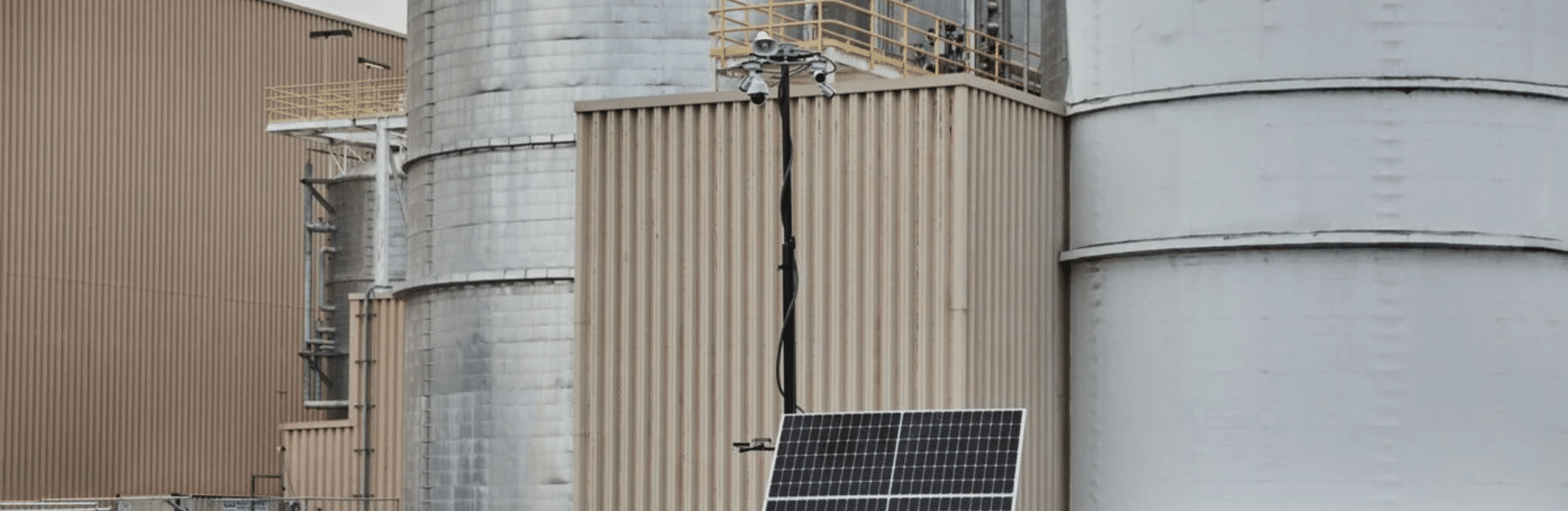
Rather than relying on permanent electrical connections and wired internet access, solar-powered MSUs can combine independent power, cellular connectivity, elevated cameras, intelligent detection, and professional remote video monitoring in a self-contained system.
The result is a way to extend security coverage to locations where traditional installation methods may be difficult, costly, or impractical.
What Is a Solar Energy Security Camera System?
In remote energy applications, a solar-powered security camera system can take the form of a mobile surveillance unit designed to operate without conventional onsite power and networking infrastructure.
Unlike a standalone camera connected to a small solar panel, an MSU brings several supporting technologies together into one deployable platform.
Depending on its configuration, a mobile surveillance unit may include solar panels, battery storage, supplemental generator power, cellular connectivity, elevated cameras, AI-assisted detection, and audible deterrence capabilities.
These components work together to support surveillance at properties that would otherwise require additional infrastructure before cameras could be installed.
| System Component | Role in Remote Energy Security |
| Solar panels and battery storage | Support operation without a conventional electrical connection |
| Supplemental generator | Provides an additional power option in configurations designed for challenging conditions |
| Cellular connectivity | Enables remote transmission without requiring wired internet service |
| Elevated security cameras | Provide visibility around designated assets, access points, and restricted areas |
| AI-assisted detection | Helps identify relevant activity that may warrant professional review |
| Live video monitoring | Connects detected events to trained personnel and established response procedures |
| Audible deterrence | Supports remote intervention when appropriate and available |
The value of this approach is integration.
Independent power allows the equipment to operate at a remote location. Wireless connectivity makes it possible to transmit relevant video. Cameras and analytics help identify activity, while professional monitoring provides a process for evaluating potential security concerns.
That doesn’t mean every MSU offers identical capabilities or can operate successfully under every environmental condition.
Power requirements, sunlight availability, cellular coverage, camera configuration, and monitoring needs must still be evaluated.
But for energy properties without convenient conventional infrastructure, a self-contained system can offer a practical alternative to building permanent camera infrastructure from the ground up.
Why Remote Substations Are a Strong Use Case for Mobile Surveillance
Electrical substations are essential components of the power grid, but many are located away from continuously staffed facilities.
They may operate with limited onsite personnel, relying on scheduled maintenance, inspections, and remote operational systems rather than a permanent employee presence.
That operating model creates a distinct security challenge.
A substation may contain valuable copper wiring, electrical equipment, and other components that could attract theft or unauthorized activity.
Damage can also create consequences beyond the replacement value of stolen materials.
Depending on the affected equipment, an incident may require repairs, inspections, specialized personnel, or operational adjustments before normal service can resume.
For this reason, energy and critical infrastructure security requires attention to both asset protection and operational continuity.
The Infrastructure Gap
A substation may have the electrical infrastructure needed to perform its utility function without having accessible, suitable connections for a conventional surveillance installation at every required camera location.
Similarly, a remote property may lack wired internet connectivity suitable for transmitting video to a monitoring center.
Extending power and networking to distant perimeter locations can introduce additional engineering, installation, and maintenance requirements.
For some sites, those investments may be appropriate.
For others, particularly where surveillance needs are temporary, evolving, or concentrated around specific assets, independently powered mobile equipment may provide a more practical option.
A solar-powered MSU can help establish coverage without requiring the same permanent electrical and network connections.
However, the deployment must still have adequate solar exposure, suitable cellular or wireless connectivity, and a safe, accessible location for the unit.
Protecting Assets Without Permanent Onsite Staffing
The absence of continuous onsite personnel also changes how security incidents may be discovered.
At a staffed facility, employees may notice an unfamiliar vehicle, damaged fencing, or suspicious activity near restricted equipment.
At an unmanned substation, those events could go unnoticed until someone visits the property.
A professionally monitored surveillance system creates an opportunity to identify relevant activity sooner.
Cameras positioned around designated access points or valuable equipment can provide video for AI-assisted detection and professional review.
If an event warrants attention, monitoring personnel can follow established procedures rather than relying exclusively on the next scheduled maintenance visit to reveal the problem.
This is particularly valuable when a facility’s geographic isolation makes routine physical observation difficult.
Independent Power Makes Remote Surveillance Possible
Solar-powered MSUs address one of the most fundamental barriers to conventional remote surveillance: the absence of convenient electrical service.
Solar panels generate electricity, while battery storage supports system operation when solar generation is unavailable or insufficient.
This arrangement can support cameras, communications equipment, and other components without requiring a permanent connection to the facility’s electrical infrastructure.
However, solar-powered surveillance needs to be engineered around the complete system’s energy requirements.
The cameras aren’t the only equipment consuming electricity.
Cellular communications hardware, analytics equipment, lighting, and other components may also contribute to the total power demand.
Seasonal sunlight availability, weather conditions, temperature, and the site’s geographic location can influence how the system performs.
For example, a remote utility property in an area with frequent cloud cover or limited winter sunlight may require a different power configuration from a location with consistently strong solar exposure.
Some MSUs incorporate supplemental generator options to support demanding environments or periods when solar generation and battery storage may not be sufficient.
The important consideration isn’t whether the system includes solar panels.
It’s whether the complete power configuration can support the intended surveillance operation under the site’s actual conditions.
That distinction matters when evaluating energy security camera solutions for long-term deployment.
A self-contained power system can reduce dependence on conventional infrastructure, but its design still requires an understanding of the site’s operating environment.
Cellular Connectivity Extends Security Beyond the Facility Network
Providing power to a remote camera is only one part of the challenge.
The equipment also needs a reliable way to transmit video and security events.
At an established commercial property, surveillance cameras may use Ethernet connections or other networking infrastructure to communicate with recording and monitoring systems.
Remote substations and utility sites may not have those connections available.
Cellular connectivity provides another option.
With an appropriately configured cellular connection, a mobile surveillance system can transmit relevant video and monitoring information without requiring a conventional wired internet service at the property.
This can be especially useful at distributed sites where installing dedicated networking infrastructure would be impractical.
But connectivity needs to be verified during deployment planning.
A location may have limited cellular signal because of its geography, terrain, or distance from available network infrastructure.
Environmental conditions and network capacity can also influence video transmission.
The required connectivity should be assessed against the cameras, monitoring service, and other system functions that depend on it.
A surveillance unit may be physically capable of operating at a remote site, but that doesn’t automatically mean it can support the intended monitoring service from every location.
Both independent power and dependable communications are necessary for an effective remote deployment.
The Camera Is Remote. The Security Response Still Needs a Plan.
Consider a person entering a restricted area near electrical equipment at an unmanned substation.
A camera may capture the activity, creating footage that can be reviewed later.
But if nobody becomes aware of the event until a maintenance crew arrives, the opportunity to intervene may already have passed.
Professional energy security camera monitoring supports a different approach.
AI-assisted analytics can help identify activity that meets established detection criteria, such as a person entering a designated restricted area.
A trained monitoring professional can review the available video, evaluate the situation, and determine whether action is warranted under the site’s monitoring instructions.
Depending on the circumstances and available capabilities, that response may include continued observation, a live audio warning, notifying designated utility personnel, or escalating verified activity to law enforcement.
This creates a defined path from detection to professional evaluation and response.
For remote infrastructure, that process can be especially important because the nearest employee or responder may be some distance away.
However, live video monitoring does not eliminate the physical challenges of responding to isolated locations.
Geographic distance, access requirements, available personnel, and local emergency resources can still influence how quickly someone can reach a site.
The benefit is the opportunity for earlier awareness and escalation, rather than waiting for the incident to be discovered after the fact.
Monitoring procedures should also reflect the unique operating conditions of energy facilities.
Authorized maintenance personnel, contractors, and utility crews may access the property at different times. A vehicle arriving outside routine hours isn’t automatically evidence of a threat.
Accurate site instructions and professional verification help distinguish expected activity from events that warrant attention.
For energy live security camera monitoring, the goal is to connect technology with a response process that accounts for the practical realities of protecting remote infrastructure.
Beyond Substations: Where Solar-Powered MSUs Fit
Substations are an important application, but they aren’t the only energy properties that can benefit from self-contained surveillance.
Energy operators may manage portfolios containing numerous remote, temporary, or geographically dispersed locations.
Different sites may require different approaches to power, connectivity, coverage, and monitoring.
Solar Farms and Renewable Energy Facilities
Large solar energy facilities may contain extensive perimeter fencing, remote access points, inverters, electrical infrastructure, and maintenance areas.
Solar-powered mobile surveillance can help provide coverage in locations where permanent cameras or network connections aren’t readily available.
These systems may be particularly useful during construction, expansion, or temporary maintenance activities when security requirements change as the project progresses.
Battery Energy Storage Sites
Battery energy storage facilities contain valuable equipment and electrical infrastructure that may require protection against unauthorized access, theft, or vandalism.
Where suitable infrastructure is unavailable, self-contained surveillance can provide visibility around designated access points, restricted areas, and equipment locations.
Camera positioning, site safety requirements, and deployment suitability should be evaluated before installation.
Utility Construction Projects
New substations, transmission-related projects, and utility infrastructure upgrades may require security before permanent site infrastructure is complete.
Construction equipment, stored materials, and valuable electrical components can be exposed during these phases.
Mobile surveillance units can provide flexible coverage while the project evolves, with the ability to reassess and reposition equipment as site conditions change.
Remote Equipment and Materials Storage
Utilities may temporarily store transformers, cable, vehicles, or other equipment at locations away from established operations facilities.
These storage areas may not justify permanent camera infrastructure, particularly when the security requirement has a limited duration.
Solar-powered surveillance units can help establish coverage around designated assets without requiring an extensive permanent installation.
Temporary Maintenance and Repair Projects
Maintenance activities sometimes create temporary security requirements at remote infrastructure locations.
Equipment may be staged onsite, access arrangements may change, or an area may require additional monitoring during scheduled work.
A relocatable surveillance platform can help address those needs and be reassigned when the project is complete.
Across these applications, the common advantage is the ability to deploy security infrastructure where it is needed without requiring conventional power and networking connections at every location.
Distributed Energy Assets Need Flexible Security
Energy infrastructure often extends across large geographic areas.
A utility may be responsible for multiple substations, maintenance locations, renewable energy sites, and temporary projects, each with different security requirements.
Installing permanent surveillance infrastructure at every location may not always be practical.
Some properties may already have appropriate cameras and connectivity. Others may require new permanent equipment. Still others may benefit from independent, relocatable surveillance.
Mobile surveillance units can provide flexibility within that broader security strategy.
A unit may support coverage at a remote construction location before being reassigned to an equipment yard or temporary maintenance project.
Where appropriate, equipment can also be repositioned to address changing coverage priorities within the same property.
That flexibility may reduce the need to construct permanent infrastructure for short-term security requirements.
However, relocation still requires planning.
The new location must support appropriate solar exposure, connectivity, camera placement, physical access, and equipment operation.
Monitoring instructions and detection settings may also require adjustments.
The advantage of mobile surveillance isn’t that it can simply be dropped anywhere and expected to work.
It’s that security coverage can be adapted as operational requirements change, provided each deployment is properly assessed.
For energy organizations managing distributed infrastructure, that adaptability can help align surveillance resources with the locations and assets that currently require protection.
What Should Energy Operators Evaluate Before Deployment?
A solar-powered surveillance unit can address several infrastructure challenges, but successful deployment depends on site suitability.
Before selecting a system, energy operators should evaluate the conditions that influence reliable operation and monitoring effectiveness.
| Deployment Consideration | What to Evaluate |
| Power requirements | Can the solar and battery configuration support the intended operation under local sunlight and weather conditions? |
| Supplemental power | Is generator support appropriate for the site’s reliability requirements? |
| Cellular connectivity | Is suitable wireless coverage available to support video transmission and monitoring? |
| Camera placement | Can the unit provide useful visibility around critical equipment and access points? |
| Terrain and access | Can the equipment be safely delivered, positioned, secured, and maintained? |
| Detection capabilities | What activity should the analytics identify, and where should monitoring be prioritized? |
| Professional monitoring | Who reviews relevant events, and which response procedures are established? |
| Ongoing maintenance | How will equipment performance, connectivity problems, and technical issues be addressed? |
| Deployment duration | Is the requirement temporary, long-term, or likely to change as operations evolve? |
These considerations are especially important because remote locations can be difficult to access for troubleshooting or maintenance.
A system that loses power, cannot transmit video, or provides inadequate camera coverage may not deliver the intended security capabilities.
For that reason, surveillance design should begin with the site’s operating conditions and known security exposures.
The equipment configuration should follow those requirements.
A remote substation with limited cellular coverage may need a different approach from a utility construction project with reliable wireless service and favorable solar conditions.
Similarly, a location requiring surveillance around one restricted equipment area may not need the same camera arrangement as a large outdoor materials yard.
The objective is to select a system that can operate reliably and provide useful monitoring within the practical constraints of the site.
Remote Doesn’t Have to Mean Unmonitored
The lack of conventional power or internet infrastructure can make remote energy security more complicated, but it doesn’t automatically rule out professional video surveillance.
Solar-powered mobile surveillance units provide an alternative approach by bringing together independent power, wireless connectivity, cameras, intelligent detection, and monitoring capabilities.
For substations and other distributed energy assets, that can help establish security coverage where permanent installation would be difficult or impractical.
The most effective applications begin with an understanding of the property’s vulnerabilities, available infrastructure, and operating conditions.
Solar and battery power must support the equipment’s electrical requirements.
Connectivity must enable the intended monitoring functions.
Cameras need to provide useful visibility around critical assets and access points.
And professional monitoring needs to be supported by appropriate site instructions and response procedures.
When these elements work together, remote surveillance becomes more than a camera operating independently at an isolated location.
It becomes a coordinated security capability designed around the realities of protecting energy infrastructure.
The value of solar-powered surveillance isn’t simply that it operates without a power outlet. It’s that it can bring professional security monitoring to locations where conventional surveillance infrastructure may not exist.
Secure Remote Energy Sites Without Permanent Infrastructure
Remote substations and utility facilities shouldn’t have to rely solely on occasional site visits because conventional power or network connections are unavailable. ECAM’s solar-powered mobile surveillance units combine independent power, wireless connectivity, intelligent detection, and professional video monitoring to help protect critical infrastructure. Speak with a Security Expert about a solution designed for your site’s conditions and security requirements.
Build a Stronger Security Strategy
Download Security Guides
Practical ebooks to help you strengthen your security and solve your challenges.

Discover Industry Security Solutions
See how ECAM protects your industry with solutions designed to deter crime, reduce losses, and keep operations moving.


